
Joshua 13:1–7 & Joshua 24
I’ve been studying Joshua and Judges lately, and there is this one tiny detail that I keep coming back to.
At the end of the book of Joshua, Joshua leaves the people of Israel with a final charge. If they want to possess the land, they must keep the covenant. And at the center of that covenant, and it is the center of the Ten Commandments themselves, is this: “I am the LORD your God, who brought you out of the land of Egypt, out of the house of bondage. You shall have no other gods before Me” (Exodus 20:2–3).
Joshua puts it plainly to the people: “Fear the LORD, serve Him in sincerity and in truth, and put away the gods which your fathers served on the other side of the River and in Egypt. Serve the LORD!” (Joshua 24:14). And the people answer just as plainly: “Far be it from us that we should forsake the LORD to serve other gods” (Joshua 24:16).
It sounds so simple when they say it. But keep reading.
The Land They Didn’t Take
Toward the end of Joshua, the text walks tribe by tribe through the allotment of the land; who gets what portion of Canaan. At first glance, it reads like a victory lap. You’d assume the conquest is complete, the cities emptied, the Canaanites driven out.
They weren’t.
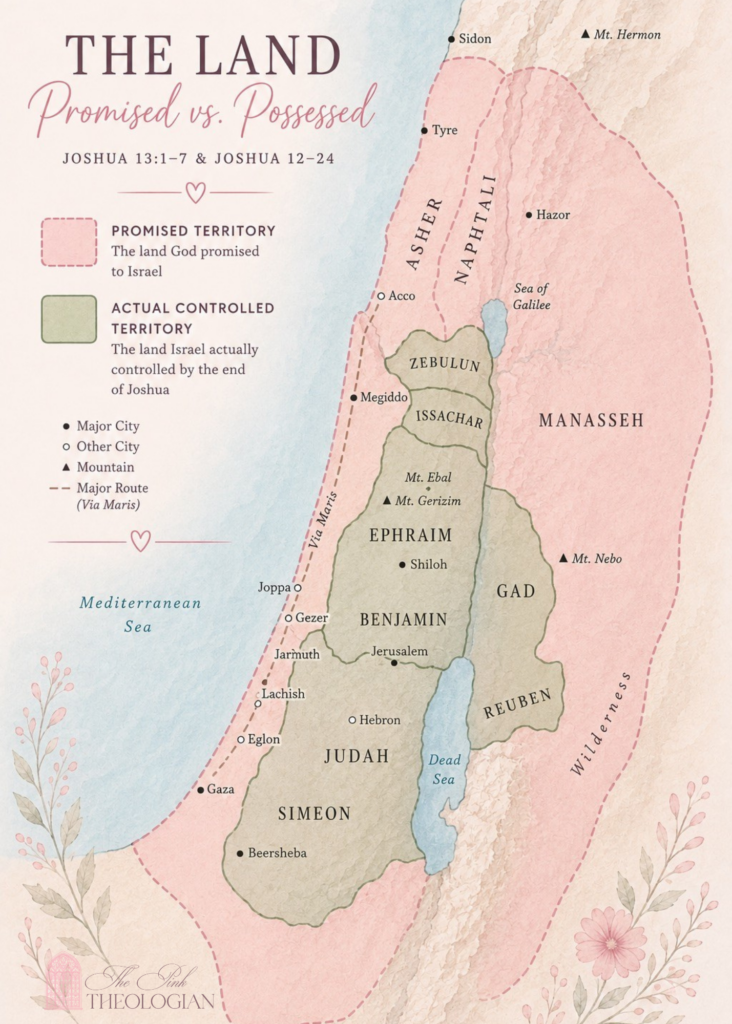
Joshua 13:1 says it outright: “There remains very much land yet to be possessed.” And from there, the chapter is stitched together with one but after another:
- “The children of Israel did not drive out the Geshurites or the Maachathites” (Joshua 13:13).
- “The children of Manasseh could not drive out the inhabitants of those cities… they put the Canaanites to forced labor, but did not utterly drive them out” (Joshua 17:12–13).
Israel had begun the work of possessing the Promised Land. They had not finished it. There’s a real difference between the land God promised and the land Israel actually possessed, which the map above shows you. The pink is the promise. The green is what they actually held by the time Joshua’s story closes. That gap between the two is where the whole book of Judges is about to happen.
Why the Land Mattered So Much
The promise of Canaan wasn’t a side detail; it was load-bearing. It was first given to Abraham, repeated to Moses, and finally handed to Joshua to carry out. There’s no version of the story where it gets skipped. If Abraham’s children were going to become a “great nation” (Genesis 12:2), if “all the families of the earth” were going to be blessed through him (Genesis 12:3), if a Messiah was eventually going to be born for all people – Canaan had to be conquered (Genesis 15:7). Even the exodus itself, that great deliverance out of Egypt, was aimed at this one destination.
So when Joshua leads the tribes across the Jordan, he knows exactly what’s at stake. “Be strong and of good courage” (Joshua 1:7) isn’t a pep talk; it’s marching orders for the sake of the whole plan of God moving forward.
Why It Was So Hard
It’s easy to shake our heads at Israel here. Just take the land. God already promised it to you, what’s the holdup?
But put yourself in their sandals. When the tribes crossed into Canaan, they didn’t move into empty territory; they moved into a land saturated with other gods. El, Baal, Asherah, Anat, Mot, Dagon, Chemosh, Molech. Temples and shrines on every high hill, in every grove of green trees. Each god was represented by a carved, dressed, fed idol that had to be kept content, because an unhappy god meant a bad harvest, a barren womb, a failed flock.
In the polytheistic mind of a Canaanite, these gods were territorial; they belonged to this particular land. So, for a settled Israelite family, refusing to honor Baal (the god of rain and fertility) or Asherah (the goddess of pregnancy and birth) wasn’t just theologically inconvenient. It felt genuinely risky. It meant staking your family’s food, your flocks, your future on an invisible God while all your neighbors hedged their bets with gods you could see, touch, and appease.
That takes conviction. That takes courage. It is exhausting to swim upstream against a cultural current that everyone around you insists is simply how the world works.
What This Looks Like for Us
Here’s where I think Israel’s story stops being ancient history and starts being a mirror.
We don’t build shrines to Baal on our high hills. But we do live in a culture with its own resident gods: comfort, image, autonomy, approval, financial security, the endless promise that if I could just get this one thing, I’d finally feel settled. They’re just as territorial as Canaan’s gods ever were. They shape what we assume is normal to want, to fear, to chase. And going against them costs something real: being the “difficult” one, the “outlier,” the person your coworkers or even your family quietly can’t quite figure out.
Paul names this directly: “Do not be conformed to this world, but be transformed by the renewing of your mind, that you may prove what is that good and acceptable and perfect will of God” (Romans 12:2). Notice that he doesn’t say resistance is optional for the especially devout. He assumes the pull toward conformity is the default current every believer has to actively swim against.
Bonhoeffer understood this cost better than almost anyone in the modern era. He drew a hard line between what he called cheap grace, the belief that costs a person nothing, changes nothing, and quietly conforms to whatever the surrounding culture already wants; and the costly grace of actually following Christ, which will, sooner or later, put you at odds with the world around you. Israel’s half-finished conquest is a picture of exactly that temptation: settling for enough faith to feel covered, without ever finishing the harder work of actually dispossessing the gods still living in the corners of your life.
Peter picks up the same thread when he calls believers “a chosen generation, a royal priesthood, a holy nation, His own special people” (1 Peter 2:9), urging us as “sojourners and pilgrims” to resist what wars against the soul (1 Peter 2:11). We were never meant to blend seamlessly into the land we’re passing through.
So, do we have to be weird for the sake of being weird? No. But do we have to be people of conviction, willing to look different because our loyalty lies somewhere the world can’t see? Yes. Every single time.
The question Joshua leaves ringing in the air isn’t really did Israel get the land. It’s will they finish what they started, tribe by tribe, gate by gate, or will they settle for partial obedience and call it enough?
I think that’s the question sitting in front of most of us, too. Not “do I believe in God” but “is there still land in my own life I’ve stopped fighting to possess?”

Be the first to comment