
On the day we now call Pentecost Sunday, an ordinary house in Jerusalem became the most extraordinary place on earth. A sound like a violent rushing wind filled the room. Tongues of fire descended and rested, not on an altar, not on a mountaintop, not on a golden ark, but on people. And then those people began to speak in languages they had never learned, proclaiming the works of God to a crowd gathered from every corner of the known world.
It sounds like something out of a dream. But Pentecost is not a strange, isolated miracle. It is the culmination of a story God has been writing since Eden, and it is still being written today. Because the same Holy Spirit who fell in that Upper Room is still moving, still speaking, still setting hearts on fire.
Let’s walk through the full story of Pentecost: its ancient roots in the Old Testament, the watershed moment of Acts 2, and what it means for us as the living Church right now.
The Ancient Roots: Pentecost in the Old Testament
The Feast of Weeks
Long before the events of Acts 2, Pentecost was already a sacred day on the Jewish calendar. Known in Hebrew as Shavuot (“the Feast of Weeks”), it was one of three great pilgrimage feasts God commanded Israel to celebrate in Jerusalem, the others being Passover and the Feast of Tabernacles.
The name we use, Pentecost, comes from the Greek word pentēkostē, meaning “fiftieth.” It fell exactly fifty days after Passover (counting seven full weeks, or forty-nine days, then celebrating on day fifty, see Leviticus 23:15–16). It marked the end of the barley harvest and the beginning of the wheat harvest, a time for Israel to bring their firstfruits offerings to the Lord and celebrate His provision.
Leviticus 23:15–17 — You shall count seven full weeks from the day after the Sabbath… Then you shall present a grain offering of new grain to the Lord. You shall bring from your dwelling places two loaves of bread to be waved… as firstfruits to the Lord.
It was a day of gratitude, of communal rejoicing, of recognizing that they depended entirely on God for their material prosperity. The entire occasion was one of offering and praise.
Jews later connected the Feast of Weeks with another pivotal moment: the giving of the Law on Mount Sinai. The fifty days between Passover and Shavuot mirrored the journey from Egypt to the foot of the mountain, making Pentecost not only a harvest celebration but a commemoration of God writing His covenant on stone tablets. That detail becomes deeply significant when we reach Acts 2.
The Number That Preaches: Fifty and the Year of Jubilee
Before we even get to the wind and fire, the number itself is already saying something.
Fifty is the number of Jubilee. In Leviticus 25, God commanded Israel to count seven cycles of seven years, forty-nine years, and then on the fiftieth year, trumpets would sound across the land and everything would be reset. Debts canceled. Slaves freed. Land returned to its original owners. Families restored. The Hebrew word for this year is yobel, the root of our English word “jubilee,” and it was inaugurated with the blowing of the ram’s horn.
Leviticus 25:10 — You shall consecrate the fiftieth year and proclaim liberty throughout the land to all its inhabitants. It shall be a Jubilee for you, when each of you shall return to his property and each of you shall return to his clan.
The Jubilee wasn’t just freedom, it was freedom with full restoration. You didn’t walk out of bondage empty-handed. You walked out with your inheritance returned, your family reunited, your land back under your feet. God’s economy has no permanent losers. Every fifty years, the slate was wiped clean.
Now consider this, when the Holy Spirit falls on the fiftieth day after Passover, the number is already loaded with meaning. Pentecost is the ultimate Jubilee. The disciples had been waiting, grieving, hoping, and praying, and on the jubilee number, heaven opened. The great divine reset began. Not of land and debt, but of sin and death and the wall between God and humanity.
And here is a detail worth sitting with: Abraham once asked God if He would spare the city of Sodom for the sake of fifty righteous people (Genesis 18:24–26). God said He would. He couldn’t find fifty. But on the day of Pentecost, three thousand people were made new in a single afternoon. God didn’t find fifty righteous, He made thousands.
Fifty is the number of completion leading to a new beginning. Freedom that moves forward into mission. Release that becomes restoration. Every time the number fifty appears in Scripture, it is pointing toward this morning in Jerusalem when the Spirit arrived and the Church was born.
The Fire and Wind of God’s Presence
Throughout the Hebrew Bible, mysterious windstorms and fire are consistently associated with two things: God’s presence and the formation of a temple or dwelling place.
Consider the pattern:
- The burning bush (Exodus 3): God appears to Moses through fire that does not consume. He speaks in Moses’ own language, declares the ground holy, a temple moment, and commissions Moses to free Israel from oppression.
- Mount Sinai (Exodus 19:16–20): When God descends to give the Law, the mountain is wrapped in smoke and fire, with thunder, lightning, and a violent trumpet blast. The people tremble. God marks this mountain as His dwelling place.
- The Tabernacle and Temple: When Israel builds God’s dwelling place, a great column of fire hovers above it. The visible sign that God’s glory has taken up residence among His people.
Every one of these fire-and-wind moments signals the same thing: God is here. This is His temple. When Luke records the events of Acts 2, he is deliberately echoing all of these scenes. The divine fire that once rested on mountains and altars and golden arks now rests on something far more surprising, on people.
The Shadow Points to the Substance
The apostle Paul teaches us in Colossians 2:16–17 that the feasts of Israel are “a shadow of things to come, but the substance belongs to Christ.” Picture a tree and its shadow: the shadow gives you a rough idea of the shape, but it’s the tree itself that has weight and texture and life.
The Feast of Weeks was a beautiful shadow. The firstfruits of the harvest pointed forward to the firstfruits of something far greater, the harvest of human souls into God’s Kingdom. The giving of the Law on stone pointed forward to the day God would write His law on human hearts, just as Jeremiah had prophesied:
Jeremiah 31:33 — I will put My law within them, and I will write it on their hearts. And I will be their God, and they shall be My people.
All of it, every harvest feast, every mountaintop fire, every temple dedication was pointing forward to one Spirit-soaked morning in Jerusalem.
The Day Itself: Acts 2 and the Birth of the Church
The Setting
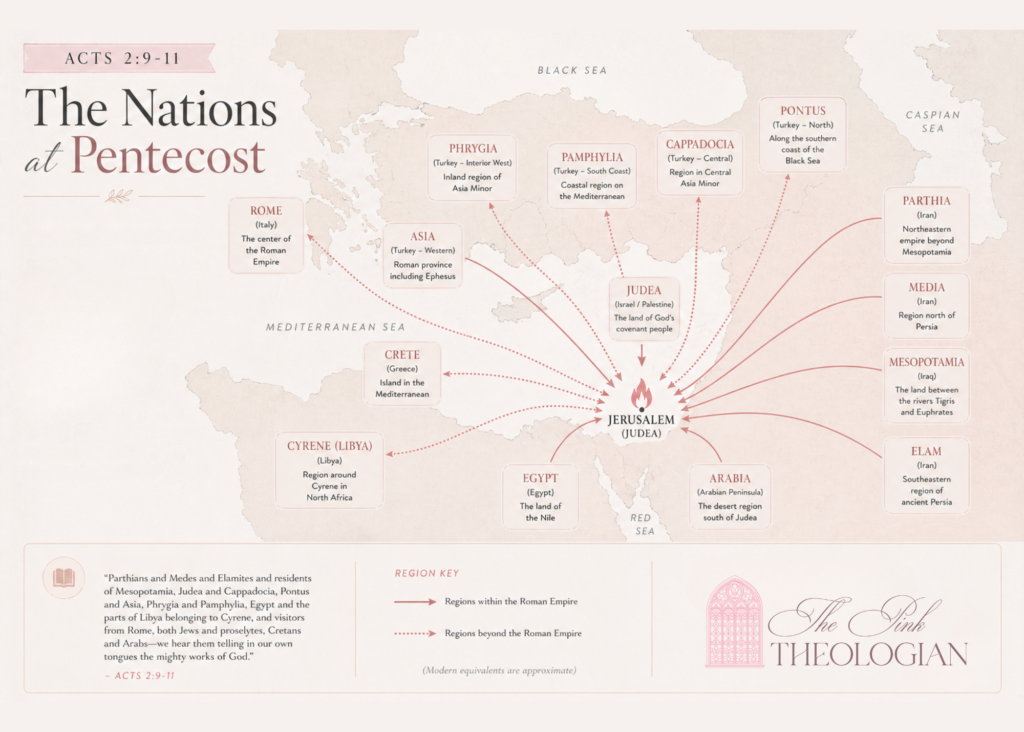
Pentecost Sunday, in the year of our Lord’s resurrection, found Jerusalem packed. Jews from every nation under heaven had traveled to the city for the feast, Parthians, Medes, Elamites, residents of Mesopotamia, Egypt, Libya, Rome, Crete, Arabia. The list in Acts 2:9–11 reads like a world map.
Tucked into a house somewhere in that city were about 120 followers of Jesus. Ten days earlier, they had watched Him ascend into heaven. He had told them to wait. He had promised they would be baptized with the Holy Spirit. He had quoted Isaiah and spoken of a coming empowerment to be His witnesses “to the remotest part of the earth” (Acts 1:8). They were waiting. They were praying. And then heaven moved.
Tucked into a house somewhere in that city were about 120 followers of Jesus. Ten days earlier, they had watched Him ascend into heaven. He had told them to wait. He had promised they would be baptized with the Holy Spirit. He had quoted Isaiah and spoken of a coming empowerment to be His witnesses “to the remotest part of the earth” (Acts 1:8). They were waiting. They were praying. And then heaven moved.
The Wind, The Fire, the Languages
Acts 2:1–4 — When the day of Pentecost had come, they were all together in one place. And suddenly a sound like a violent rushing wind came from heaven, and it filled the whole house where they were sitting. And tongues that looked like fire appeared to them, distributing themselves, and a tongue rested on each one of them. And they were all filled with the Holy Spirit and began to speak in other tongues as the Spirit gave them utterance.
The wind. The fire. The languages. Each one carries enormous theological weight.
The wind echoes every previous moment when God’s breath brought life, from the Spirit hovering over the waters in Genesis 1, to the breath that filled Adam’s lungs in Genesis 2, to the wind that filled the valley of dry bones in Ezekiel 37 and raised them to life. The Pentecost wind represents God’s power to bring life to what was once dead.
The fire echoes every previous theophany (A theophany is a manifestation of God in the Bible that is tangible to the human senses), every moment in Scripture when fire signaled that God had arrived. But notice what is different here: the fire does not rest on a mountain or an altar. It distributes itself and rests on each one of them. Not a group. Not a representative. Each person. Individually. This is the signature of the new covenant.
And the languages: the Greek word for “tongues” (glōssa) can refer to actual human languages, and that’s clearly what Luke intends here. The crowd hears the apostles, all Galileans, all speakers of the same dialect, declaring the mighty works of God in their own native languages. People from over a dozen language groups all hear their own tongue. It is Babel in reverse.
The Reversal of Babel
Back in Genesis 11, God confused the languages of humanity at the Tower of Babel, scattering the people across the earth. It was a judgment, yes, but it was also a mercy with God limiting the reach of human pride. But it fractured the human family. From that day forward, language became a wall.
At Pentecost, the wall comes down. Not by erasing difference, but by the Spirit moving across every language at once. The good news of Jesus is not a Jewish message dressed in Greek. It is for every tongue, every tribe, every nation. What began at Babel as division finds its redemption at Pentecost in the gift of the Spirit.
Peter’s Sermon and the Joel Connection
When the bewildered crowd accuses the disciples of being drunk, Peter stands up and preaches. And the first thing he does is reach all the way back to the prophet Joel:
Joel 2:28–29 (quoted in Acts 2:17–18) — And it shall come to pass afterward that I will pour out My Spirit on all flesh; your sons and your daughters shall prophesy, your old men shall dream dreams, and your young men shall see visions. Even on the male and female servants in those days I will pour out My Spirit.
Peter’s message is unmistakable. What Joel saw from eight centuries away, we are watching happen right now. God has poured out His Spirit, not on priests only, not on kings only, not on prophets only but on all people. No barrier of sex, class, age, or ethnic background can stop the Spirit’s work.
Peter doesn’t preach about the Spirit, though. He preaches about Jesus. His death, His resurrection, His exaltation to the right hand of the Father, and His identity as the promised Messiah. The Spirit’s role, as Jesus Himself said in John 16:14, is not to draw attention to Himself but to glorify Christ.
The response is staggering. The crowd is “cut to the heart” (Acts 2:37), and about three thousand people are baptized that day. Three thousand firstfruits of the spiritual harvest. The Church has been born.
A Temple Made of People
Here is perhaps the most stunning thing Luke wants us to see in Acts 2: when the divine fire descends and rests on each person, it is declaring them a temple.
Every previous fire-and-glory moment in Scripture marked a sacred space: a mountain, a tabernacle, a temple made of cedar and gold. But on the day of Pentecost, the fire doesn’t rest on a building. It rests on people.
God is declaring something new and radical: He no longer dwells in a geographic place or a constructed space. His dwelling is in the community of those who follow Jesus. People who carry His presence. People who operate like Jesus, loving without partiality, welcoming the outsider, and ending fear with love. The Church is God’s new temple, and it is made of living stones.
This is not metaphor meant to comfort us. It is a declaration about how the world will be changed. Heaven and earth overlap wherever the Church gathers. God’s Kingdom advances wherever His people go. Pentecost is, in the truest sense, the beginning of a new world.
The Gifts Are Still Alive: What Pentecost Means for the Church Today
An Outpouring Without Borders
One of the most radical things about Pentecost is who the Spirit fell on. In the Old Testament, the Spirit came on specific individuals set apart for special office, The prophets, priests, and kings. It was extraordinary and selective. But Joel’s prophecy pointed to something entirely different: an outpouring on all people.
Sons and daughters. Old men and young men. Male and female servants. The Spirit of God would no longer be reserved for a spiritual elite. Every believer would have access to the same presence and power that once rested only on the anointed few.
And that is exactly what happened. And it is still happening.
The Gifts Are Not a Museum Exhibit
Some traditions teach that the gifts of the Spirit like prophecy, tongues, healing, words of knowledge, miracles were only for the first-century Church, given to authenticate the apostles and then withdrawn once the New Testament was complete. But this view doesn’t hold up against Scripture or church history.
Joel didn’t prophecy a temporary outpouring. Peter didn’t preach a short-term promise. The Spirit wasn’t poured out for a season, the Holy Spirit was given to the Church as a permanent inheritance. Paul’s instructions about the proper use of gifts in 1 Corinthians 12–14 make no sense if those gifts were about to disappear. He wouldn’t write three chapters of guidance for something already on its way out.
The promise of Acts 2:38–39 is plain:
Acts 2:38–39 — Repent and be baptized every one of you in the name of Jesus Christ for the forgiveness of your sins, and you will receive the gift of the Holy Spirit. For the promise is for you and for your children and for all who are far off, everyone whom the Lord our God calls to Himself.
For you. For your children. For all who are far off. The promise has no expiration date.
God’s Law Written on Our Hearts
And there is one more thread to tie together. Remember that the Jewish Feast of Weeks celebrated the giving of the Law on Mount Sinai, when God wrote His covenant on stone tablets. And remember Jeremiah’s prophecy that a day would come when God would write His law not on stone, but on hearts.
That day is Pentecost. The same Spirit who empowers us for gifts and ministry is also the One who sanctifies us, who makes us more like Jesus from the inside out. He is, as Paul says in Ephesians 1:14, the guarantee of our inheritance. He not only effects our salvation; He perfects it. He draws us into union with Christ and keeps us there.
The Holy Spirit is not just power for ministry. He is the presence of God living inside you. He is your Comforter, your Teacher, your Counselor, your Friend. He is the fulfillment of Jesus’ promise: “I will not leave you as orphans” (John 14:18).
Daughters Shall Prophesy: Pentecost and the Equal Outpouring
They Were There
Here is something the Sunday school version of Pentecost often leaves out: women were in that upper room. They were not in an adjacent room. They were not waiting outside. They were there, praying alongside the eleven apostles, and when the fire fell, it fell on them too.
Luke is deliberate about this. In Acts 1:13–14, he lists the apostles by name and then adds: “All these continued together in prayer with one mind, together with the women, along with Mary the mother of Jesus, and His brothers.” The group of about 120 waiting for the promised Spirit explicitly included women. And when Acts 2:4 says “all of them were filled with the Holy Spirit,” that all is not a footnote. It means everyone in the room.
Mary herself is worth pausing on. This was not her first encounter with the Spirit’s power. In Nazareth, decades earlier, the Spirit had come upon her and she had carried the Son of God. She said yes then, at great personal cost, not fully knowing what it would mean. Now she sits in a crowded upper room and receives the Spirit again. Not as a private, silent miracle, but alongside the whole gathered community, on equal footing with every person there.
What began quietly and singly through one young woman in Nazareth overflowed onto the streets of Jerusalem through men and women together. Mary’s yes was still reverberating.
Why Peter Quoted Joel
When the crowd outside hears the commotion and accuses the disciples of being drunk, Peter stands up and explains what is happening. He reaches back eight centuries to the prophet Joel, and the reason he chose that passage matters more than we usually notice.
The crowd wasn’t just confused by the languages. They were confused by the women. In first-century Jerusalem, seeing women standing in public streets proclaiming spiritual truth was not ordinary. It was startling. Some sources suggest the accusation of drunkenness was partly aimed at the women in the group, a way of dismissing what they couldn’t explain.
Peter’s response is to quote the one prophecy that addresses exactly this: “your sons and your daughters shall prophesy… even on My servants, both men and women, I will pour out My Spirit.” He is not making a passing reference. He is giving a theological explanation for what the crowd is seeing. The daughters prophesying is not a malfunction. It is the fulfillment.
The Greek word for “prophesy” here carries the full weight of what prophets did in the Old Testament; not just predicting the future, but proclaiming God’s message, preaching His word, declaring His works. Joel promised it. Peter confirmed it. The women on those streets were not out of order. They were exactly where God intended them to be.
Women in the Old Testament Who Went Before
This wasn’t entirely new ground. The Old Testament already had a lineage of women who prophesied and led. There is Miriam, Moses’ sister, who is explicitly called a prophet in Exodus 15:20. Deborah served as both judge and prophet over all of Israel in Judges 4. Huldah (who is tragically often overlooked) was a prophet whose word King Josiah and the high priest sought out, even when male prophets were available (2 Kings 22:14–20).
These women were not anomalies or exceptions to a rule. They were part of a pattern God was establishing: when He has a message, He sends it through whoever He chooses. The Jubilee promise of Pentecost included this too. There are no more restrictions of the Spirit’s voice to a select few. The daughters would speak. And they would be heard.
The Legacy Continues Through Acts
The women don’t disappear after Acts 2. Luke, who is notably careful to name and include women throughout his gospel, continues tracking them through the growth of the early Church in the book of Acts.
Philip the evangelist had four daughters who prophesied (Acts 21:8–9). Priscilla and her husband Aquila worked alongside Paul as tentmakers and teachers, and in four of the six times the couple is mentioned in the New Testament, Priscilla’s name comes first. In that culture, naming a woman before her husband signaled greater prominence. When they sat down with the gifted teacher Apollos to correct his incomplete theology, Luke names Priscilla as the lead voice. Lydia, a businesswoman in Philippi, became the first baptized convert in Europe and opened her home as the gathering place for the first European church.
These were not women sneaking ministry in through the back door. They were women the Spirit specifically called, equipped, and sent in plain sight, in the historical record, named for us to see.
A Personal Word
I want to say something here that feels important to name directly.
I write Scripture-based content publicly through The Pink Theologian. I teach, I study, I proclaim and Pentecost is the theological foundation under all of it. The Spirit was poured out on daughters. The daughters prophesied. That is not a secondary theme in the Pentecost story. It is woven into Peter’s very first sermon as an explanation of what everyone was witnessing.
If you have ever felt like the story of the Church wasn’t quite written for you. if you have sat in a service where “anyone” somehow seemed to mean someone who doesn’t look like you I want you to read Acts 2 again. Slowly. The fire rested on each one of them. Not on the qualified. Not on the prominent. Not only on the men. On each one.
You are not outside the story. You are in it. You were always in it. Pentecost said so from the very first day.
Take It Further With the Full Bible Study
If this post stirred something in you and you want to sit with it longer, I put together a Bible study to go alongside everything we’ve covered here. Five sessions, lined reflection questions, Scripture readings, and a closing prayer, all designed to walk you through the complete Pentecost story from the OT roots all the way through Acts 2 and into what it means for your life today. It works beautifully alone or with a small group, and it pairs perfectly with the reference card.
→ Grab the “Fire Fell on Her Too” Bible Study + Reference Card bundle
Happy Pentecost: The New World Has Begun
Pentecost Sunday is not a minor footnote on the church calendar. It is the birthday of the Church. It is the moment God moved from dwelling in temples made of stone to dwelling in temples made of people. It is the day the promise of Eden, the covenant with Abraham, the prophecy of Joel, and the words of Jesus all converged in a rush of wind and a crown of fire.
And it is not ancient history. Every time the Spirit moves, every time a believer prophesies or prays in tongues or lays hands on the sick, every time the gospel crosses a language barrier and finds a home in a new heart Pentecost continues. The harvest is still coming in. The temple is still being built.
We do not have to travel to a sacred mountain to meet with God. We do not have to stand outside a temple court waiting for access. The curtain was torn, and the Spirit was poured out, and now God’s presence is as close as your next breath because He lives in you.
That is something worth celebrating every Sunday. But especially this one.
Happy Pentecost
Key Scriptures Referenced
- Genesis 18:24–26
- Exodus 15:20
- Leviticus 23:15–22
- Leviticus 25:10
- Exodus 19:16–20
- Judges 4:4
- 2 Kings 22:14–20
- Joel 2:28–32
- Jeremiah 31:3
- Luke 1:26–38
- Acts 1:1–15
- Acts 2:1–47
- Acts 18:1–26
- Acts 21:8–9
- John 14:12–18, 26
- John 16:5–15
- 1 Corinthians 12–14
- Ephesians 1:14
- Colossians 2:16–1

Be the first to comment