
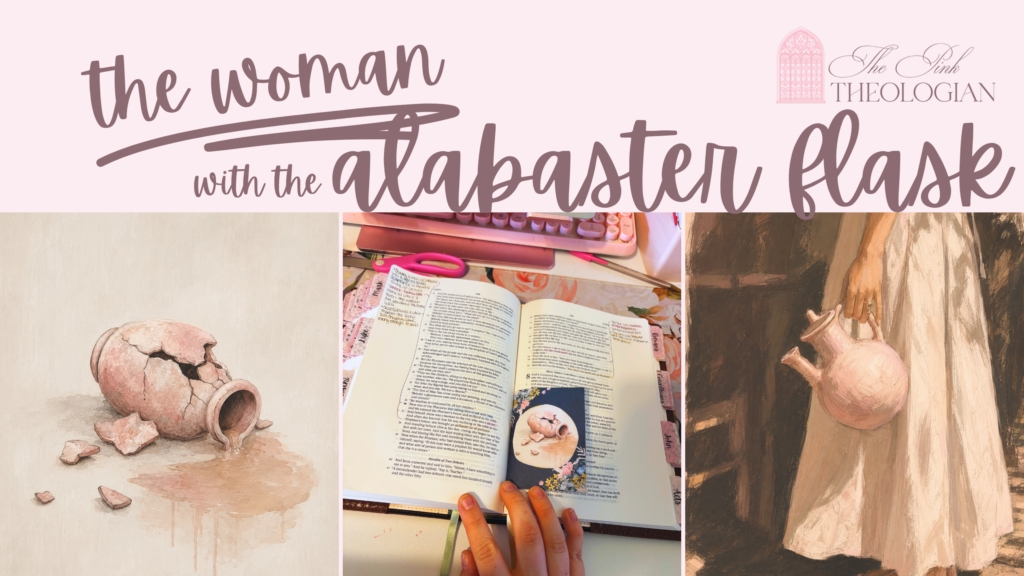
Of all the women in the Gospels, the woman with the alabaster flask has always stopped me in my tracks.
Studying the women of the Bible has been a lifelong passion of mine, and the longer I study them, the more convinced I become that God has always seen women fully, valued them completely, and intentionally recorded their stories. Named or unnamed, spoken or silent, every single woman in Scripture matters to God. And when Jesus came and began His earthly ministry, He made that unmistakably clear in the way He treated the women He encountered.
Jesus protected women. He empowered them. He honored them publicly and released their voices. He was funded by women, confided in women, celebrated women by name, learned from women, and held women up as examples worth following. Despite what you may have heard, the Bible does not diminish women; it dignifies them. And Jesus is the clearest proof of that.
That is exactly why studying these passages matters so much. When we study the women of Scripture, we are not doing a niche Bible study for a niche audience. We are studying the character of God, a God who has always seen the ones the world overlooked, and who has always had something to say through them.
This woman in Luke 7 is no exception.
We are going to work through this passage exegetically. Meaning we are going to let the text drive the conversation. We will move through it section by section, paying close attention to what Luke actually says, what the historical and cultural context adds, and what it all reveals about the character of God. Grab your Bible, your journal, and something to write with. Let’s go verse by verse.
Before we dive in, I want you to read the passage in three different translations, slowly, without rushing to the commentary or the questions. Let the text speak first. Here it is in the NKJV:
Then one of the Pharisees asked Him to eat with him. And He went to the Pharisee’s house, and sat down to eat. And behold, a woman in the city who was a sinner, when she knew that Jesus sat at the table in the Pharisee’s house, brought an alabaster flask of fragrant oil, and stood at His feet behind Him weeping; and she began to wash His feet with her tears, and wiped them with the hair of her head; and she kissed His feet and anointed them with the fragrant oil. Now when the Pharisee who had invited Him saw this, he spoke to himself, saying, “This Man, if He were a prophet, would know who and what manner of woman this is who is touching Him, for she is a sinner.” And Jesus answered and said to him, “Simon, I have something to say to you.” So he said, “Teacher, say it.” “There was a certain creditor who had two debtors. One owed five hundred denarii, and the other fifty. And when they had nothing with which to repay, he freely forgave them both. Tell Me, therefore, which of them will love him more?” Simon answered and said, “I suppose the one whom he forgave more.” And He said to him, “You have rightly judged.” Then He turned to the woman and said to Simon, “Do you see this woman? I entered your house; you gave Me no water for My feet, but she has washed My feet with her tears and wiped them with the hair of her head. You gave Me no kiss, but this woman has not ceased to kiss My feet since the time I came in. You did not anoint My head with oil, but this woman has anointed My feet with fragrant oil. Therefore I say to you, her sins, which are many, are forgiven, for she loved much. But to whom little is forgiven, the same loves little.” Then He said to her, “Your sins are forgiven.” And those who sat at the table with Him began to say to themselves, “Who is this who even forgives sins?” Then He said to the woman, “Your faith has saved you. Go in peace.”
The Room: Luke 7:36
It is an ordinary dinner in first-century Galilee, and then it isn’t.
A Pharisee named Simon has invited Jesus to recline at his table. This is not as unusual as it might sound. Even though the Pharisees largely opposed Jesus, He accepted these invitations when they came. He was not interested in keeping a safe distance from people who needed Him, regardless of which side of the social ledger they occupied. Wealthy or poor, powerful or marginalized, religious or scandalous: Jesus sat down with people. So He reclines at Simon’s table, and the meal begins.
In the ancient world, a dinner like this would not have been a private affair. Doors stayed open. The curious could enter, sit at the edges of the room, and listen to the conversation of the honored guests. Jesus was a known public figure by this point in His ministry, and people followed where He went.
That open door is what makes the next moment possible. She walked through it.
📖 Study question: What does it tell you about Jesus’ character that He accepted this dinner invitation, even knowing the Pharisees opposed Him? What does that suggest about how He pursues people?
The Woman: Luke 7:37–38
Luke introduces her with a single description: she was a sinner.
That is all the text gives us. No name. No specific sin identified. No occupation assigned. Just a sinner. Known in the city as one. Which means that when she walked through that open door, past the reclining guests, past the table, and straight to Jesus, every person in that room already knew her reputation. And she knew that they knew.
Now I want to pause here for just a moment, because that word sinner has not always been handled carefully by the people who have taught this passage.
There are commentators who will tell you that because Luke calls her a sinner, she must have been a prostitute, a “fallen” woman in a specific, sexual sense. But that reading brings something to the text that the text itself does not provide. The Greek word Luke uses here is hamartōlos. And that is the exact same word used just two chapters earlier, in Luke 5, when Peter falls at the feet of Jesus and cries out: “Go away from me, Lord, for I am a sinful man!” (Luke 5:8, NKJV)
No one reads a specific sexual sin into Peter’s confession. No one calls Peter a prostitute. Luke uses hamartōlos for both of them. This is because she is a sinner in the same way Peter is a sinner. The same way you and I are sinners. She came carrying the weight of who she was before God. That’s it. That’s enough.
And I want to honor that restraint, because I think Luke’s restraint is deliberate. He does not give us her name. He does not give us her sin. He gives us her posture, and that is what matters for what happens next.
What the text does make clear is that she had already encountered Jesus before this moment. She had to have. You do not walk into a Pharisee’s house uninvited, carrying something this precious, weeping at the feet of a Rabbi, unless something has already broken open inside you. She did not come to investigate Jesus. She came because she already knew what He had done for her. She came, as Matthew Henry observed, out of love, out of gratitude, because she had already been forgiven much. Her act of worship was not the beginning of her relationship with Jesus. It was the overflow of it.
📖 Study question: Luke uses the same Greek word for her sin that he uses for Peter’s in Luke 5:8. What does that tell you about how God defines who is welcome at the feet of Jesus? What barriers, real or assumed, do we place between certain people and access to Him?
The Flask: Luke 7:37–38
She brought something with her: an alabaster flask of fragrant oil.
Alabaster was a white, marble-like stone, soft enough to carve, strong enough to seal. It was the material of choice for storing expensive perfume, because its density kept the fragrance pure and contained. These flasks were often sealed with wax. To release what was inside, you sometimes had to break them open.
The perfume itself would have been staggeringly expensive. If the ointment was spikenard-based, as parallel accounts suggest, its value could represent close to a full year’s wages for an ordinary worker. Some scholars have proposed it may have been a dowry, an inheritance, or resources she had saved over the years. Whatever it was, it was not something spent lightly.
She brought it all. And she poured it all out.
Guests reclined at the table with their feet extended behind them. She came to the place where the feet were, behind Him, in the position of a servant, and she wept. Her tears fell on His feet. She let down her hair in public, a startling act of vulnerability in that culture, and wiped His feet with it. She kissed them. She anointed them with everything in that flask.
She counted the cost, and she paid it without hesitation, because getting close to Jesus was all she cared about.
📖 Study question: The alabaster flask was sealed, its contents preserved until the moment of pouring. What does it mean to you that she broke it open at His feet specifically? What had to be true about who she believed Jesus to be for her to make that choice?
The Pharisee’s Objection: Luke 7:39–47
Simon watches all of this and arrives at a conclusion he keeps to himself: “This Man, if He were a prophet, would know who and what manner of woman this is who is touching Him, for she is a sinner.” (Luke 7:39, NKJV)
It is a revealing thought. Simon believes holiness requires distance from the sinful; that a truly righteous man would recoil from this woman’s touch rather than receive it. He cannot see past her reputation. He sees her history and stops there. He has cataloged her sin, formed his verdict, and closed the file.
But Jesus reads his mind. He answers the thought Simon never said aloud, and He does it with a parable.
“There was a certain creditor who had two debtors. One owed five hundred denarii, and the other fifty. And when they had nothing with which to repay, he freely forgave them both. Tell Me, therefore, which of them will love him more?” (Luke 7:41–42, NKJV)
Simon answers correctly: the one forgiven more will love more.
Then Jesus turns the lens from the woman to the host. He walks Simon through a quiet, devastating comparison. The woman has done what Simon did not; she washed His feet when Simon offered no water; she greeted Him with kisses when Simon offered no greeting; she anointed Him with precious oil when Simon offered nothing. None of these were required. But the woman’s lavish presence and the host’s pointed absence says everything about where love actually lives in that room.
📖 Study question: Simon saw a sinner. Jesus saw someone with the capacity for great love. What does that difference reveal about how God sees people? How does that challenge the way you see others, or yourself?
The Theological Heart of the Passage: Luke 7:47–50
Here is the moment we must not rush past, because getting it wrong changes everything.
“Therefore I say to you, her sins, which are many, are forgiven, for she loved much. But to whom little is forgiven, the same loves little.” (Luke 7:47, NKJV)
At first glance, this verse can sound as if love earns forgiveness, as if she poured out the oil and was therefore granted a pardon. But the parable corrects that reading before the verse even arrives. In the parable, the debts are canceled first. Then love follows. The creditor forgave both men, and because of that forgiveness, love grew in proportion to what had been released.
Her love did not earn her forgiveness. Her love was the evidence of her forgiveness.
And then Jesus confirms it in the plainest possible terms: “Your faith has saved you. Go in peace.” (Luke 7:50, NKJV)
Faith. Not works. Not the perfume or the tears or the hair or the hours she spent weeping at His feet. As beautiful and moving as all of that was. Faith. She believed in who Jesus was, and that faith had already saved her. Everything she poured out was simply the overflow of a heart that had already been made new.
This is the theological sequence Luke records: an offer of forgiveness from God, received by faith, overflowing into love. The love does not generate the forgiveness. The forgiveness generates the love.
Matthew Henry put it plainly: her love was great because she had been forgiven much. This was not a performance. This was not a religious effort aimed at earning favor. This was a woman who had received something she could never repay and could not contain.
📖 Study question: How does getting this sequence right, forgiveness first, love as response change how you understand your own relationship with God? What shifts when you see love as overflow rather than obligation?
What Jesus Does Next
The religious experts at the table hear Jesus pronounce forgiveness over this woman and they are unsettled: “Who is this who even forgives sins?” (Luke 7:49, NKJV)
They are asking the right question, even if they are asking it in the wrong spirit. They know their theology well enough to know that the forgiveness of sins belongs to God alone. That is not a power a prophet claims. That is not something a teacher announces. What Jesus has just done is appropriate to Himself the authority of God, and He does it calmly, without argument, in the middle of an interrupted dinner party.
He does not defend Himself. He simply turns back to the woman.
“Your faith has saved you. Go in peace.”
She came through an open door into a room full of people who knew exactly who she was. She came carrying something precious and poured it all out at the feet of a man, whom the religious establishment could not figure out what to do with. She said nothing, not a single word is recorded, and yet she is the most eloquent person in that room. And Jesus, who needs no one’s permission, looks at her and sends her out in peace.
She came one way. She left another way entirely.
What This Means for You
Before you move on, pause here.
The woman in Luke 7 demonstrates something that is easy to admire and hard to imitate: she overcame every barrier: social, cultural, and personal, because her love for Jesus was greater than her fear of what the room thought of her. She was not performing. She was not earning. She was responding, with everything she had, to a grace she had already received.
Consider these questions slowly. Write your answers down if you can.
What is in your flask right now? What are you carrying into your time with God? Worries, distractions, grief, guilt, gratitude, questions you are afraid to ask? The woman did not arrive empty-handed. She arrived full, and she poured it out. You are allowed to bring everything.
Have you truly reckoned with what you have been forgiven? Jesus told Simon that small love often signals a failure to understand the depth of one’s own forgiveness. Not a performance failure, a perception failure. Is it possible that your love for God feels thin not because something is wrong with you, but because you have not yet fully stood in the weight of what He has already done for you?
Who do you see when you look at the people around you: their sin, or their potential? Simon saw a sinner and closed the file. Jesus saw someone capable of extraordinary love. Ask God to give you His eyes for the people in your life.
Big Thinking Questions: Reflecting on God
These questions are for deeper study, journaling, or group discussion. They are centered not on what you feel, but on what this passage teaches you about who God is.
- What does it reveal about the character of God that Jesus, fully knowing who this woman was and what she had done, not only received her worship but defended her publicly?
- God forgives freely, without requiring that the debt be partially paid first. The creditor in the parable forgave both debtors fully, not proportionally. What does that tell you about the nature of God’s forgiveness? How does that differ from how we tend to think about what we “deserve”?
- Jesus saw Simon’s private thought and answered it. He sees what is unspoken, what is hidden, what we have only said to ourselves. What does the omniscience of God mean for how you come to Him, in prayer, in study, in worship?
- The forgiveness Jesus pronounced over this woman was the exclusive act of God. The people at the table knew it “Who is this who even forgives sins?” What do you believe about who Jesus is, based on what He does in this passage?
- The woman left “in peace” the Hebrew word is shalom, a wholeness and completeness that only God can give. What does it tell you about God that He does not merely pardon sin but sends us out whole?
Ready to Go Deeper?
If this passage stirred something in you, if you want to keep sitting with this woman, this scene, and what it reveals about the heart of God, I have something for you.
The Alabaster Method Bible Study Guide is available now in my Etsy shop. It is a full, in-depth Bible study framework built on this very passage. Designed to help you come to God’s Word the way this woman came to Jesus: with everything you have, ready to pour it out, and expectant for what He will give you in return.
It walks you through all four movements: Empty, Receive, Respond, Full with guided prompts, study tools, and space to go as deep as you want to go. Whether you work through it alone or with a group of women, it will meet you where you are.
Shop the Alabaster Method Bible Study Guide on Etsy → Alabaster Method Bible Study Guide
And if you want to keep studying alongside me, the next post in this series walks through the Alabaster Method framework itself, what it is, how it works, and how to use it in your everyday time with God.
Empty. Receive. Respond. Full. — An Introduction to the Alabaster Method → coming soon!

Be the first to comment