
I own a black T-shirt covered in portraits of prominent figures in Black history. I wore it to work one day when I was teaching at a private Christian school and nearly got fired for it.
The irony is that the shirt wasn’t the whole story. What had actually raised eyebrows was something I had said in class: that I don’t observe Black History Month. Or Women’s History Month. Or any designated history month, for that matter. My conviction, then and now, is simple: all history deserves to be learned, at all times, not parceled out into tidy calendar observances and then quietly set aside. My students thought I was a progressive agitator. My colleagues weren’t sure what to make of me. What I actually was, and still am, is a historian who refuses to curate the past.
I still wear that shirt. I’m wearing it right now, actually, as I write this, sitting at my desk with a stack of church history books beside me. Because that same conviction that got me nearly fired applies here too, and perhaps nowhere more urgently than in the church.
Church history has a selective memory. We are very good at telling the stories that flatter us, the creeds, the councils, the Reformers, the great missionaries. We are considerably less practiced at telling the stories that complicate us, the ones that require us to sit with discomfort before we arrive at glory. The history of the church and slavery in America is one of those stories. And tucked inside it is something that most Christians have simply never been taught: Juneteenth was born in a church. It was organized by pastors. And the Black congregations who created it had spent the previous year doing something that looks, from a church history perspective, remarkably like the Reformation.
That is the story I want to tell here.
On June 19, 1866, several thousand men and women filled the streets of Houston, Texas. They assembled that morning at a small wooden Methodist church in the Fourth Ward, paraded through the center of town beneath a canopy of American flags, and gathered at a grove on the city’s outskirts for speeches, singing, and a meal. At the head of the procession rode two ministers: Reverend Elias Dibble, a Methodist pastor who had been born into slavery, and Reverend Sandy Parker, a Baptist minister who would later serve as a city alderman.
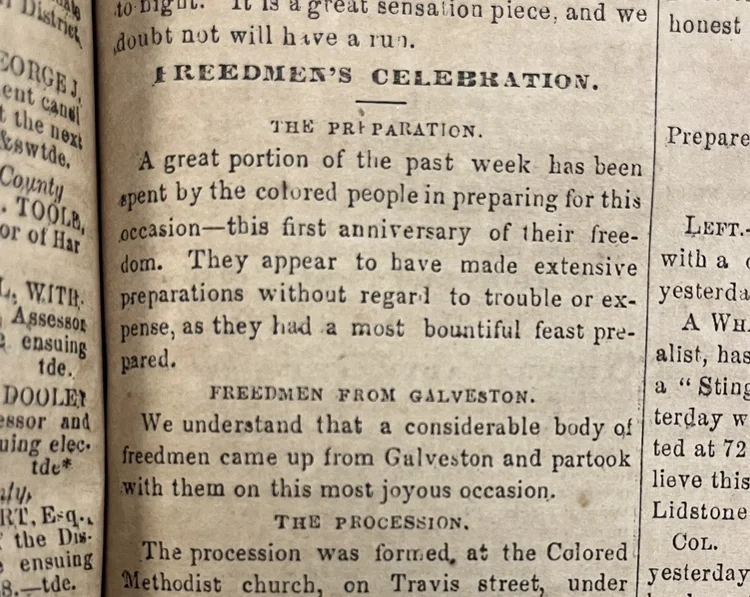
It was the first recorded public observance of June 19 as an anniversary of emancipation, the celebration the world would come to know as Juneteenth. And it began, as so many of the most significant moments in American history have, inside the church.
The Event That Made the Anniversary Possible
To understand what happened on June 19, 1866, you have to understand what happened on June 19, 1865.
One year earlier, Union Major General Gordon Granger had arrived in Galveston, Texas, and read General Order No. 3 aloud to the city:
“The people of Texas are informed that, in accordance with a proclamation from the Executive of the United States, all slaves are free.” (General Order No. 3, Galveston, Texas, June 19, 1865)
President Lincoln had issued the Emancipation Proclamation on January 1, 1863, declaring all enslaved people in Confederate states legally free. The Civil War had ended in April 1865. But Texas had seen little Union military presence throughout the war, and the machinery of enforcement had not reached it. Some slaveholders actively withheld news of emancipation and it is worth noting that enslaved people themselves were not passive recipients of this silence; they actively gathered and circulated information about the war’s progress throughout the conflict (Caleb McDaniel, “The Origins of Juneteenth,” Journal of Texas History, 2026). It was not until Granger arrived in Galveston that the proclamation became, for 250,000 enslaved Texans, a living reality rather than a distant document.
The 13th Amendment, formally abolishing slavery across all states, was ratified that December. But it was June 19 that freedpeople in Texas would remember, not the proclamation on paper, but the moment freedom arrived with force. Freedpeople in Texas would remember not the proclamation on paper, but the moment freedom arrived with force.
The Black Church Was Already Moving
What most Juneteenth histories skip over is what the Black church in Texas was doing in the twelve months between Granger’s arrival and that first Houston celebration.
The answer is remarkable: it was breaking free.
For decades, enslaved Black Christians in Texas had worshipped within biracial, segregated church structure, not by choice, but by the design of a slave society that used even religion as an instrument of control. Black members of Houston’s First Baptist Church had long been supervised by white committees. According to historian Charles A. Israel, Black members had already begun holding “their own services and disciplinary conferences, but under the supervision of a committee of three white members” before the war’s end (Israel, as cited in McDaniel, “The Origins of Juneteenth”). Black Methodists shared a lot with white Methodists, worshipping in a separate building on the same property, under white oversight.
After emancipation, these congregations moved swiftly and decisively toward independence. Sandy Parker was among twelve Black members who formed a new congregation in January 1866, what would eventually become Antioch Missionary Baptist Church, one of the most historically significant Black churches in Houston’s history (McDaniel, “The Origins of Juneteenth”). They petitioned the white-led Union Baptist Association for full and equal recognition. The association hedged, insisting their delegates always be drawn from the white First Baptist Church. Parker’s congregation pursued autonomy anyway.
Elias Dibble had moved even earlier. On March 5, 1865, before the Confederate surrender, Dibble and a small group of Black Methodists had begun organizing their own church, aligning with the Northern Methodist Episcopal Church rather than the proslavery Methodist Episcopal Church, South. By December 1865, Dibble had been appointed as their minister. The new board of trustee, Peter Noble, Charles Chapman, Frank Vance, Edwin Brooks, Samuel Noble, and John Sessums purchased a city block on the southwestern edge of Houston in February 1866 and relocated their wooden church building, plank by plank, to land they now owned (McDaniel, “The Origins of Juneteenth”).
That land acquisition mattered. It was not merely practical it was theological and political. As one Methodist newspaper noted, “under the new order of things, they are guaranteed the rights of property, and may protect it before the law” (The New Orleans Advocate, March 1866, as cited in McDaniel). For a people who had themselves been classified as property, owning property was an act of profound defiance and profound faith. By the time June 19, 1866 arrived, it was Dibble’s newly relocated church that served as the assembly point for the march. The celebration of freedom from slavery was inseparable from the celebration of freedom from proslavery churches. The two liberations had happened together, and Dibble’s congregation had spent the year making both real.
The March Itself
The context of that first march is important and often overlooked.
Five days before June 19, white Houstonians had staged a pro-Confederate firemen’s parade through the same city streets, complete with cheers for Jefferson Davis, a band playing “Dixie,” and a float featuring a young white girl in mourning for the “dead nation,” wearing manacles on her hands (Flake’s Bulletin, Galveston, June 17, 1866, as cited in McDaniel). A statewide election over the terms of Reconstruction was set for June 25. The political temperature in Houston was, to put it mildly, combustible.
Dibble and Parker led their people into those streets anyway.
The procession that morning was carefully and deliberately organized. The day’s officers wore sashes of red, white, and blue. The marchers carried what the Houston Evening Star described as “a great number of United States banners from the size of a pocket handkerchief up to a bed quilt” (Houston Evening Star, June 20, 1866, as cited in McDaniel). Behind the ministers marched Black draymen, wagon drivers whose labor was essential to Houston’s economy, followed by the city’s eldest Black residents, whose presence honored a lifetime of labor under slavery. Voluntary associations brought up the rear: the Freedmen’s Mutual Aid Society that Dibble himself had founded the previous fall, a debating society, the Baptist Mutual Aid Society, and then a vast crowd of individual marchers, “male and female, old and young, large and small” (Houston Evening Star, June 20, 1866).
At the grove, the Evening Star‘s correspondent noted that the “good sisters were singing their spiritual songs.” Three thousand to four thousand people gathered, more than the entire Black population of Houston at the time, swelled by visitors from Galveston and the surrounding countryside. The Tri-Weekly Telegraph later confirmed what some white Houstonians had tried to dispute: the celebration “was altogether in the hands of the negroes” (Tri-Weekly Telegraph, Houston, July 13, 1866, as cited in McDaniel). It was organized, led, and sustained by the Black community of Houston. By its churches and its pastors.
The Abolitionist Church: A Longer Thread
The Houston story does not stand alone. It belongs to a longer and largely underappreciated tradition of the church’s involvement in the fight against slavery.
Long before Granger rode into Galveston, Christians on both sides of the Atlantic had been laboring, at great personal cost toward abolition. William Wilberforce spent the better part of his adult life in the British Parliament, animated by his evangelical Christian faith, until the slave trade was abolished in 1807 and slavery itself in the British Empire in 1833 (Eric Metaxas, Amazing Grace: William Wilberforce and the Heroic Campaign to End Slavery, HarperOne, 2007). John Newton, the former slave-ship captain who penned Amazing Grace, became a fierce abolitionist after his conversion, eventually testifying before Parliament about the horrors he had witnessed and participated in (John Newton, Thoughts Upon the African Slave Trade, London, 1788).
In America, the story is equally rich and similarly underrepresented. Charles Finney, the great revivalist, tied abolitionism directly to genuine conversion, he believed you could not claim to be born again and remain indifferent to slavery (Charles G. Finney, Lectures on Revivals of Religion, New York, 1835). John Rankin, a Presbyterian pastor in Ohio, wrote one of the earliest and most influential abolitionist texts in American history, calling slavery “a never-failing fountain of the grossest immorality” (John Rankin, Letters on American Slavery, 2nd ed., Landmark Press, 1836, p. 2). Harriet Tubman, who guided hundreds to freedom along the Underground Railroad, operated from a bedrock of biblical faith, famously saying she never ran her train off the track and never lost a passenger (Kate Clifford Larson, Bound for the Promised Land: Harriet Tubman, Portrait of an American Hero, Ballantine, 2004). Frederick Douglass’s most devastating critiques of American slavery were theological, he understood precisely that what was being practiced under the name of Christianity was a perversion of it, and he said so without apology (Frederick Douglass, My Bondage and My Freedom, 1855).
These were not peripheral figures. They were among the most prominent Christians of their era, and their opposition to slavery flowed directly from their theology: the conviction that every human being bears the Imago Dei — the image of God — and that no system which treats image-bearers as property can be reconciled with the God of Scripture. As theologian Millard Erickson writes plainly: “Because all are made in the image of God, nothing should be done to encroach upon another’s legitimate exercise of dominion. Freedom should not be taken from humans. This means, most obviously, that slavery is improper” (Millard J. Erickson, Christian Theology, 3rd ed., Baker Academic, 2013).
Why This Matters for the Church Today
Juneteenth did not emerge from a political movement. It emerged from a church building on a city block in Houston, Texas, led by two men who had spent the previous year doing the hard, unglamorous work of building free institutions for a free people.
That is a church history story. It belongs to us.
The abolitionist tradition, Wilberforce, Newton, Finney, Tubman, Douglass, and the countless unnamed believers who labored alongside them belongs to the church’s inheritance. The courage of Elias Dibble and Sandy Parker, marching through hostile streets five days after a Confederate parade, belongs to that same inheritance. And the faith of those “good sisters” singing at the grove, whose names the Evening Star did not think to record, belongs to it too.
Christians today have every reason to receive this history with gratitude and with seriousness. We stand in a long line of believers for whom the proclamation of freedom was never merely spiritual, it was embodied, costly, and real. And we serve the same Christ who stood in the synagogue in Nazareth and declared, in words that have echoed across every generation since:
“The Spirit of the LORD is upon Me… to proclaim liberty to the captives… to set at liberty those who are oppressed.” (Luke 4:18, NKJV)
He meant it then. He means it now.
Juneteenth is, at its root, a story about what happens when the church takes that proclamation seriously. It is worth knowing. It is worth telling. And it is worth celebrating.

Very insightful, inspirational, and grateful to serve a God who uses people to bring justice to all through the living word. Praise Yahweh!