
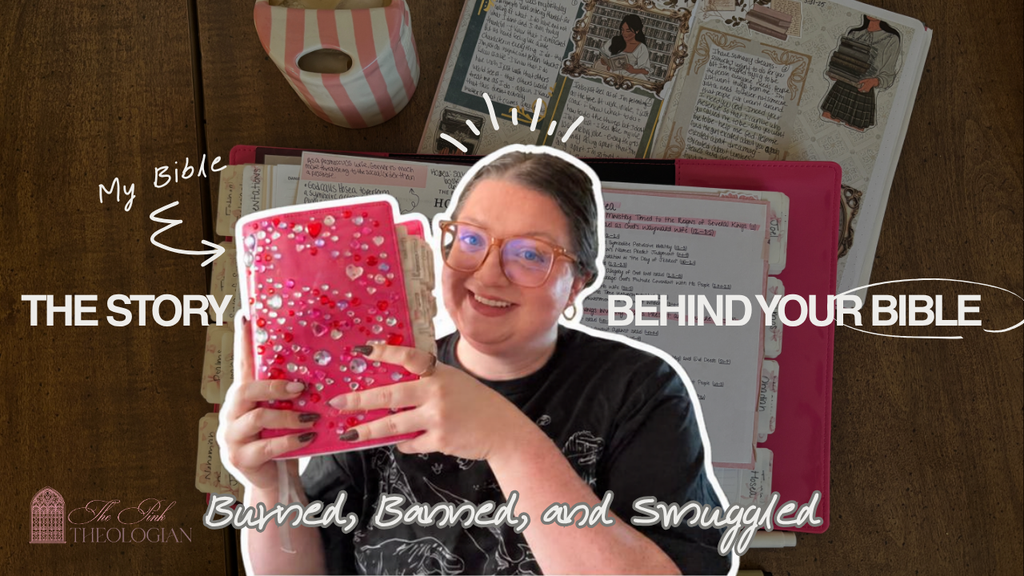
Go grab your Bible. Wherever it is right now: the nightstand, the kitchen table, the bottom of your bag under a receipt or six. I’ll wait.
Okay. Now look at it for a second. Take a really good look at it. How does it feel in your hands? Is it soft? Heavy? Can you hold it in only one hand, or do you need both? Are the pages crisp and clean, or worn and bent from use? There are no wrong answers here, but I want you to truly take your Bible in and what makes it unique.
You could buy one on a whim, and you can find one in nearly any hotel drawer in America, which is exactly why it’s so easy to forget what you’re holding. That book is a survivor. Over thousands of years, it was copied by hand, banned, burned, argued over by kings, and smuggled across borders. Somebody paid for the Bible in your hands. Some paid with years of their lives, and at least one paid with all of it.
Reformation Day is coming up on October 31, and I’d love to take a different route as we celebrate this monumental day in Church History. Grab your coffee. This trip has a monk hiding in a castle, a printer with a very good idea, an Englishman who died praying for his king, and a king who changed his mind.
The Bible Was A Library Before It Was a Book
The word Bible comes from the Greek word biblia, which simply means “books.” Plural. The root goes back to the Greek word for papyrus, byblos, which is tied to Byblos, the Phoenician port city that exported it. For most of history, nobody carried around one tidy volume as we do today. They had a library: law, history, poetry, prophecy, gospels, and letters, written by different people over roughly a thousand years, from Moses to Malachi and then on to the apostles.
The Old Testament was preserved on Hebrew scrolls that scribes copied with great care. Jesus Himself stood up in the synagogue at Nazareth, was handed a scroll, and read from it (Luke 4:16-20). The New Testament, on the other hand, started as mail essentially. Paul wrote to churches about twenty years after the resurrection, and those churches read his letters aloud, copied them, and passed them along. The Gospels were written as the eyewitnesses grew older. Peter was already counting Paul’s letters among “the rest of the Scriptures” (2 Peter 3:16, NKJV). Even the names of the two halves carry a story. The Greek word behind “testament” means covenant, so you’re holding the old covenant and the new one that Jeremiah promised (Jeremiah 31:31).
Then trouble came, so around A.D. 140, a man named Marcion decided the God of the Old Testament couldn’t possibly be the Father of Jesus, so he chopped the Bible down to a trimmed-up Luke and ten of Paul’s letters. A couple of decades later, Montanus announced himself as a fresh mouthpiece for a new revelation. One man wanted to subtract, the other wanted to add, and the church had to say plainly what belonged.
So they did. Athanasius listed all twenty-seven New Testament books in an Easter letter in A.D. 367, and the Council of Carthage affirmed that same list in 397. Notice what they weren’t doing. They weren’t handing authority to these books. They were recognizing what already carried it, asking whether a writing traced back to an apostle, whether churches were already reading it in worship, and whether it was changing lives. That worship test mattered. By about A.D. 150, Justin Martyr was describing Christian gatherings in which the memoirs of the apostles were read aloud alongside the writings of the prophets. It cost something even then. In A.D. 303, the emperor Diocletian ordered Christian Scriptures seized and burned.
When Paul wrote to young Timothy, he was pointing back to the sacred writings Timothy had known since childhood, and he said this about them: “All Scripture is given by inspiration of God, and is profitable for doctrine, for reproof, for correction, for instruction in righteousness, that the man of God may be complete, thoroughly equipped for every good work” (2 Timothy 3:16-17, NKJV).
The Latin Bible Nobody Could Read
Wanting Scripture in a language people actually speak is not a Reformation invention. Christians were doing it from the start. Within a couple of centuries, the New Testament had been translated into Latin, Syriac, and Coptic so that new believers could read it in their own tongue.
By the late fourth century, Latin was the language of the Roman world, and the Latin Bibles floating around were a tangle of competing versions. Pope Damasus handed the cleanup job to Jerome, a famously prickly scholar who knew both Hebrew and Greek. Jerome spent years bringing the Scriptures into the everyday Latin that people actually spoke. The finished work became known as the Vulgate, from the Latin word for “common.”
Common. Hold onto that word, because here comes the sad irony. Rome fell, the languages of Europe drifted, and the church kept the Vulgate anyway. For roughly a thousand years, it was the Bible of the West, and most people couldn’t read it. Most people couldn’t read at all. Every copy was made by hand, which meant months of labor and a small fortune, so owning a Bible was out of the question for nearly everyone.
So ordinary folks met Scripture in other ways: in the Latin of the Mass, in stone carvings and painted church walls (that’s why all of the old churches have stained glass windows, it was the visual Bible), in the mystery plays staged outside cathedrals at Christmas and Easter. Every bit of it passed through a priest or an artist first. Nobody was sitting down on a Tuesday night with a cup of tea and the book of Romans.
Then, in the 1380s, an Oxford theologian named John Wycliffe and his associates produced the first complete English Bible, working from the Vulgate. The motive was the same as Jerome’s: to put God’s Word into a language the common man and woman could understand. Wycliffe also argued that Scripture, and not the wealth and power of the church, was the final authority. That did not make him popular in Rome.
He died of a stroke at the end of 1384. The story didn’t end there. Decades later, church leaders declared him a heretic, ordered his writings burned, dug up his bones, burned those too, and tossed the ashes into a river. That’s an awful lot of fury aimed at a book written in English so that anyone could read it.
The Printing Press & Returning to the Classics
Skip ahead to about 1454, in Mainz, Germany. Johannes Gutenberg had been perfecting movable type, and when he needed something worthy of showcasing his invention, he chose the Bible. It was the Latin Vulgate, printed in roughly 180 deluxe copies, and buyers had claimed every one before the last pages came off the press.
I should be honest with you here. It still looked like a medieval manuscript, it was still in Latin, and it was not cheap. A copy sold for about thirty florins, roughly three years’ wages for a clerk. The press didn’t fix everything. But a door had been propped open, because books could now be made faster than any monastery full of scribes could manage.
At the same time, scholars across Europe were chanting ad fontes, “back to the sources.” Learn Greek and learn Hebrew. Read the Scriptures the way they were first written. In 1516, Erasmus of Rotterdam published a printed Greek New Testament with his own improved Latin translation set beside it. The first edition was a mess, with problems in the manuscripts and typos in the printing, but he kept refining it and produced five editions in all. Erasmus never left the Catholic Church. Still, his Greek text became the ground on which the Reformation translators would use.
A Monk, a Castle, and a German Bible
Now enter Martin Luther, an Augustinian monk who taught Scripture at the university in Wittenberg. One question tormented him: how can a sinner stand before a holy God? While teaching through Romans, he landed on a line that wouldn’t let him go. “The just shall live by faith” (Romans 1:17, NKJV). Righteousness wasn’t something he had to earn. It was something God gives.
What began as a protest against the sale of indulgences grew into a much bigger fight: who gets the final word, the church’s tradition or the Bible? Summoned before the emperor at Worms in 1521 and told to take it all back, Luther refused. His conscience, he said, was captive to the Word of God.
His protectors staged a kidnapping on the road home and tucked him away at Wartburg Castle. An outlaw with a great deal of time on his hands did something remarkable. In about eleven weeks, he translated the New Testament into German, working from Erasmus’s Greek text. It was not going to be a stuffy, scholarly Bible. Luther wanted German that sounded like Germany. Go listen to the mother at home, he said, and the kids in the street, and the shopper in the marketplace, and watch how they actually talk. Then translate like that. Printers added introductions, margin notes, and illustrations so a farmer with no seminary training could find his footing.
The New Testament came off the press in September 1522 and kept selling out. Luther and his colleagues finished the whole Bible in 1534, and between 1522 and 1546, it went through around 250 editions. Rome was not thrilled. The church condemned the translation and tried to have copies burned, and later the Council of Trent insisted the Latin Vulgate remain the official text.
A quick clarification, because this part gets misunderstood. Sola scriptura doesn’t mean “me, my Bible, and nobody else.” The Reformers read the church fathers constantly and prized good preaching. It meant that Scripture is the final authority, the court to which every other teaching has to answer.
And the fire kept spreading. More than two centuries later, on May 24, 1738, an English clergyman named John Wesley, who was struggling in his faith, went very unwillingly to a meeting on Aldersgate Street in London, where someone was reading aloud from Luther’s preface to the book of Romans. “I felt my heart strangely warmed,” he wrote afterward. A Bible put into the language of the marketplace was still setting hearts ablaze.
The Plowboy Promise
England was the hardest case. Possessing an unlicensed English Bible could cost you your life in England. William Tyndale, a gifted English scholar, set out anyway to translate directly from the Hebrew and Greek, not from the Latin, as Wycliffe had. He couldn’t do it on home soil, so he worked in exile on the continent, and by 1526 his English New Testament was being printed and smuggled back into England.
The story goes that Tyndale once told a learned man who was arguing with him that if God spared his life, he would see to it that a boy driving the plow knew more Scripture than that scholar did. He meant it, too.
He made enemies on two fronts. The church saw a threat, and King Henry VIII was furious when Tyndale spoke against the annulment of his marriage to Catherine of Aragon. Eventually, a man Tyndale had trusted betrayed him. He was convicted of heresy, strangled, and burned at the stake in 1536. His last words, as the story is told, were a prayer: “Lord, open the King of England’s eyes.”
In the craziest turn of events, within a few years of his death, English Bibles built on Tyndale’s work were being printed with the king’s own approval. More followed, including the Geneva Bible in 1560, and then the King James Version in 1611, whose wording carries Tyndale’s fingerprints all over it. Most English Bibles you can find today trace a line back to him, directly or by way of the King James tradition, and that includes the one on your nightstand.
A man gave his life so that a farmhand could read the book of Romans in English. Sit with that for a second.
Treasure What Cost So Much
Let’s put some numbers on how far we’ve come. Here’s a rough look at how many hours of work an average person needed to afford a Bible:
| Year | Time needed to work to afford a copy of the Bible |
| 1500 | 400-600 Hours |
| 1700 | 120-200 Hours |
| 1800 | 30-60 Hours |
| 1900 | about 7 hours |
| 1950 | about 2 hours |
| 1980 | about 1 hour |
| Today | 20-60 minutes |
From hundreds of hours of labor to less than one.
Here’s where I stand. Most of us don’t struggle with access anymore. We struggle with familiarity. The Bible has become so available that it’s turned into furniture, and I think that’s its own kind of tragedy. People gave everything to put this book in our hands, and some days we can’t find ten minutes to open it.
You don’t honor them by feeling guilty; you honor them by reading. You don’t honor God by feeling guilty; you honor God by reading this book that He so carefully ensured remains preserved.
Luther had a simple recipe for how. He used three Latin words: oratio, meditatio, tentatio. Pray, and ask God for His Spirit to give you understanding. Read the text slowly and then read it again, out loud if you can, especially the passages you think you already know. And let the real trials of life drive you back into the Word for answers. Nothing fancy. Just prayerful, steady, repeated reading. As the psalmist puts it, “Your word is a lamp to my feet and a light to my path” (Psalm 119:105, NKJV).
That slow, prayerful rhythm is the heartbeat behind the Alabaster Method, the study framework I built around the woman who brought her alabaster flask to Jesus in Luke 7. It moves through four movements: Empty, Receive, Respond, and Full. It’s designed to help you slow down and meet God in His Word rather than just check a box.
So here’s my Reformation Day nudge. On Saturday, October 31, the Alabaster Method goes on sale in my shop. I’m putting all of my Bible study materials on sale for 30% off. The discount is already applied, so you don’t have to worry about remembering any sort of codes. If you’ve been meaning to dust off your Bible, consider this your sign.
Selah
Take a breath before you close this tab. Here are a few questions to carry with you this week as we come up to Reformation Day:
- The Bible survived Roman fires, centuries of hand copying, and kings who wanted it silenced. What does that tell you about God’s faithfulness to His own Word?
- Luther and Tyndale fought to put Scripture in the language of farmers and shoppers. What does it reveal about God’s heart that He wants to be known by ordinary people, and not only the educated?
- Psalm 119:105 calls His Word a lamp for the feet. What does that say about how God leads His people, one step at a time?
Then do one small, tangible thing. Open the Bible you’ve been meaning to open, and read a single chapter slowly.
And if you’re ready to build out your own study shelf, I’ve gathered my favorite Bible study resources in one place.

Be the first to comment