
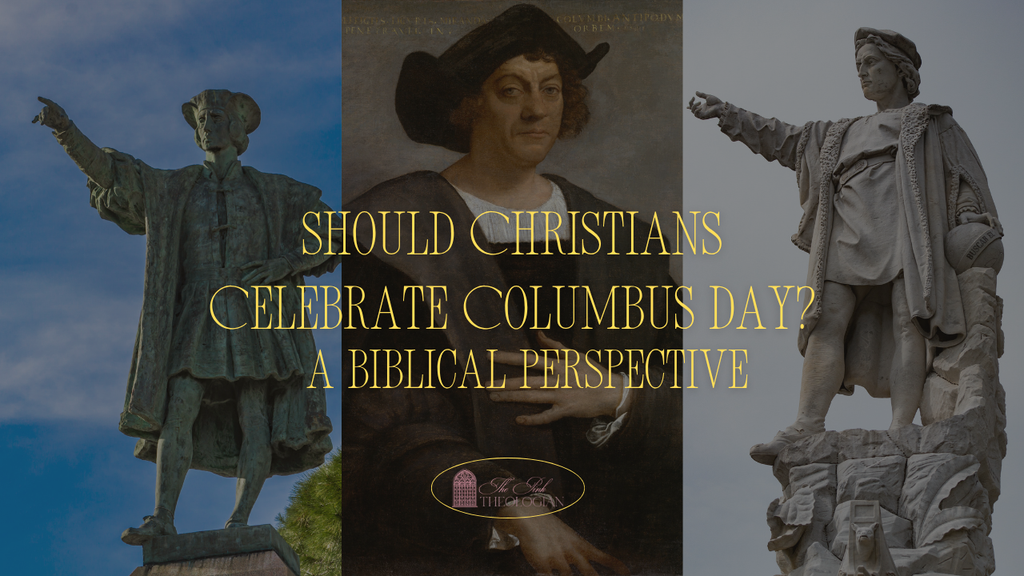
Today is the second Monday of October, which means my feed is doing its annual thing. One side posts a flag and a ship. The other posts a rebuttal with a lot of capital letters. Everybody’s certain, and almost nobody’s read a primary source. I remember first hearing the name Christopher Columbus in 3rd grade, and I had no idea that such a figure would stir up so much controversy. I wanted to look at this day from a theological standpoint.
Who was Christopher Columbus? What are we celebrating?
Cristoforo Colombo was born in Genoa around 1451, the son of a wool weaver. He went to the sea at a young age. Somewhere around 1476, the ship he was crewing on was attacked and sunk off the coast of Portugal, and he got to shore by grabbing wreckage and kicking. (Some tellings say five miles. I’d take the number with a grain of salt.) Portugal turned out to be the best place on earth to wash up, because it was the Silicon Valley of navigation in those days. He learned charts, winds, and celestial navigation, married into a family with Atlantic island connections, and by most accounts sailed down the African coast, where he watched the Portuguese gold and slave trade up close.
Then came the idea. Sail west, reach Asia, skip the long overland routes. And contrary to the popular myth, nearly every educated person already knew the Earth was round. The argument was about how big it was. Columbus shrank it on paper, leaning on friendly estimates and, by his own account, even some verses from the Apocrypha, so that Japan looked to be only a few thousand miles out. It was actually many thousands farther. The scholars on the royal panels said it was too far, and they were right. What saved him were two continents that nobody in Europe knew existed.
He spent about six years knocking on doors, first in Portugal and then in Spain, mostly collecting rejection. Then, in January 1492, Granada fell, and Ferdinand and Isabella (the King and Queen of Spain) finally said yes. He sailed in August and sighted land on October 12.
Four voyages followed between 1492 and 1504. The first was a small expedition of three ships. The second, in 1493, was a full colonizing effort with a fleet of well over a dozen ships and over a thousand men, and that’s where the gold quotas, the forced labor, and the enslavement began in earnest. In 1495, he shipped hundreds of Taíno captives to Spain, and many died on the way. On his third voyage, he touched the South American coast and became convinced he’d found the Garden of Eden. That was also the voyage that ended with Bobadilla and chains, which we’ll get to. His fourth voyage left him shipwrecked in Jamaica for about a year.
He died in 1506, comfortable, still petitioning the crown for money, and still believing he’d reached the edge of Asia. In his last years, he became consumed with prophecy. He compiled a Book of Prophecies, a collection of Scripture passages he read as pointing to his own mission, and he dreamed that the wealth of the Indies would fund the recapture of Jerusalem. He even signed his name with a little flourish that included a rendering of “Christ-bearer.”
So what are we actually celebrating? Not the first European across the Atlantic, since the Norse beat him by about five hundred years (October 9 is Leif Erikson Day, in fact). Not the man who proved the earth was round. Not the discoverer of America, since people had lived here for thousands of years. What’s left is a gifted sailor with stubborn courage who bet his life on a bad calculation and got rescued by geography, a believer who seems to have meant his prayers, and a governor who got removed from his post. That’s a real person, and a complicated one. It’s also not quite what the holiday says on the tin.
Where the holiday actually came from
Here’s a piece of the story I never got in school. In 1891, New Orleans police chief David Hennessy was murdered. Eleven Italian immigrants were arrested, most were acquitted or never convicted, and a mob broke into the jail and killed them anyway. By the usual count, it’s the largest mass lynching in American history. Italy pulled its ambassador, and talk of war was in the air.
A year later, President Benjamin Harrison proclaimed October 12, 1892, a day of celebration for “the discoverer.” Many historians read it as a peace offering to a wounded community, and Italian Americans took the holiday and ran with it. Honestly, I get it. When your neighbors hate you, a national hero who shares your birthplace is a gift. Then came the Knights of Columbus lobbying for a federal holiday in 1937, and a 1968 law that moved it to a Monday starting in 1971.
Now read what Harrison actually asked of churches that day: “expressions of gratitude to Divine Providence for the devout faith of the discoverer.” Notice what’s missing. Nothing about Columbus’s conduct, only his piety, and the piety was being used as civic glue. It’s the very thing Washington Irving did in his 1828 biography, the book that gave us the flat-earth myth and a gentle, saintly Columbus who never really existed. Also, Columbus never set foot in what became the United States. Not once.
What Columbus said, in his own words
Columbus deserves a fair hearing, so let’s give him one. Let’s look at what he has to say for himself about himself.
On that first day in the islands, he named the land San Salvador, for the Savior. He wrote that the people he met could be brought to the faith “rather by love than by force,” and he handed out red caps and glass beads to win their goodwill. That sounds like a missionary. But within days, he was also writing that the islanders were poorly armed and that a small force could subdue them and make them do as the Spaniards wished. Same journal, same week.
Then there’s the contract. The crown promised him a tenth of the pearls, gold, silver, and spices he found, plus the titles of Admiral, Viceroy, and Governor, which would be passed down to his sons forever. He had missionary zeal and a very large retirement plan, side by side.
By 1500, the zeal had a price tag. In a letter to a woman at court, Columbus described the colony’s economy plainly. Girls of nine and ten were in demand, and a good price was paid. He wasn’t confessing, he was reporting.
What others saw
Michele de Cuneo, a friend of Columbus who sailed on the second voyage, wrote casually in a letter about a captive woman the Admiral himself had given him. That’s not a rumor from an enemy. It’s a friend, bragging.
When royal investigator Francisco de Bobadilla arrived in 1500, he reportedly found Spaniards hanging from gallows and arrested Columbus and his brothers. Bobadilla was a rival, and scholars debate his report. But settlers had been complaining to Spain for years, and Columbus was stripped of his governorship. The man who ruled the colony was removed for how he ruled it.
Then there’s Bartolomé de las Casas, the one witness I trust most, partly because he’d been inside the system. Las Casas once held enslaved Indigenous people himself before repenting and spending his life fighting it. He wrote of a Taíno chief named Hatuey, tied to a stake in Cuba and about to be burned alive. A friar urged him to accept Christ and go to heaven. Hatuey asked whether Spaniards went there too. Told yes, he said he’d rather go to hell.
Hear that. A man about to be killed in the name of the gospel looked at the people carrying it and decided he wanted no part of their heaven. That’s the fruit of this whole thing, and I can’t unhear it. (Las Casas’s death tolls are almost certainly inflated, and historians say so. His eyewitness testimony still stands without them.)
What does the Bible say?
“You will know them by their fruits. Do men gather grapes from thornbushes or figs from thistles?” (Matthew 7:16, NKJV).
Not by testimony. Not by sincerity, or by how loudly they pray. Their fruit.
Jonathan Edwards built Religious Affections around this. His twelfth and final sign of true grace is that it bears fruit in Christian practice, in a life that actually bends toward holiness and mercy. John Bunyan gave us Mr. Talkative, who could discuss the faith all day and couldn’t be found in it when the work needed doing.
Scripture doesn’t leave us guessing about this particular fruit, either. “He who kidnaps a man and sells him, or if he is found in his hand, shall surely be put to death” (Exodus 21:16, NKJV). And Paul’s warning could have been written about a colony of men chasing gold: “For the love of money is a root of all kinds of evil, for which some have strayed from the faith in their greed, and pierced themselves through with many sorrows” (1 Timothy 6:10, NKJV).
C.S. Lewis warned that cruelty exercised sincerely for the good of its victims can be the most relentless kind, because the one doing it never has to feel guilty. Dietrich Bonhoeffer called it cheap grace when we keep the vocabulary of Christ and skip the cost of following Him. Martin Luther would say Columbus drifted from the theology of the cross, where God works through humility, into the theology of glory, where His name gets stamped on conquest and treasure.
So what do we do with the day?
I’m not interested in canceling a dead man, and I’m not interested in a stained-glass saint either. Honor what’s true: the courage, the sincere faith, and the heritage of a people who needed somewhere to belong. Then let the fruit speak. Where it was good, give thanks. Where it was rotten, call it rotten, and grieve for the people who ate it.
Columbus named the standard himself, and then failed it. Christians of all people should be able to say that a man can be sincere and wrong at the same time. Columbus is still a man who shifted the perspective to the West, and history was forever changed. But overall, we learn that our ability to prove that we are Christians is through our actions, words, and deeds. People will know who we are and who we claim to belong to through that. Columbus is a vital example of that lesson for us to learn.

Be the first to comment