
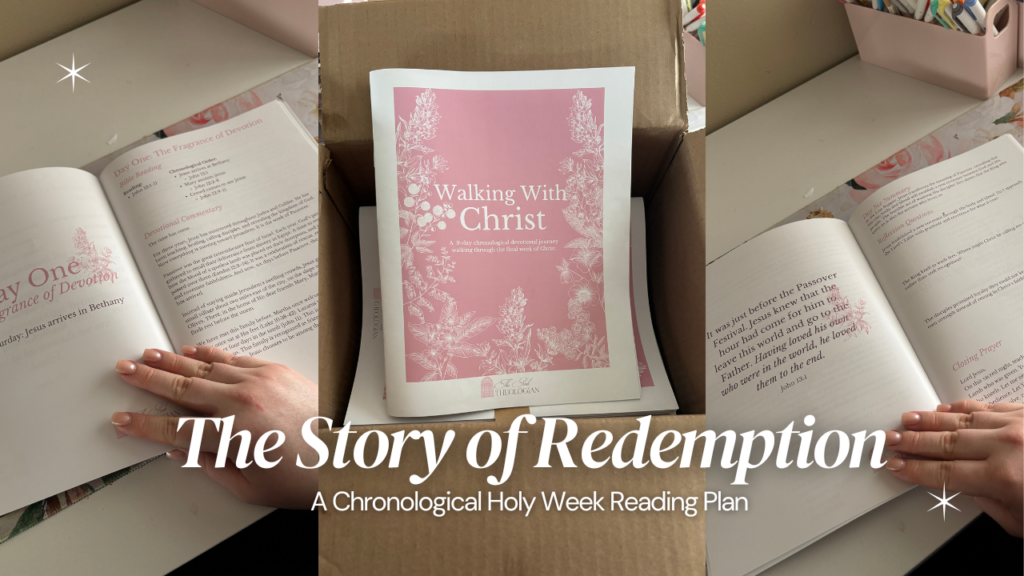
Every spring, the world begins to wake up again. Flowers bloom, the air softens, and new life pushes through the ground. For Christians, this season mirrors the very heart of our faith: redemption.
Easter has become one of my favorite times of the year. I’m a spring baby at heart, and Easter brings to mind lilies (a flower my Gran loved.) I think of bright pastels (and considering I am the Pink Theologian, you can probably guess why I love pastel colors) and the way that both spring and Easter point to the same beautiful reality: redemption.
Redemption is one of those Christian words that gets used often. Sometimes as Christians we assume everyone understands the meaning behind these familiar terms. But we can easily take for granted the depth behind these foundational concepts. I never want to do that. It’s something I jokingly refer to as “Christianese.”
So, to make sure we are on the same page, let’s define redemption.
In simple terms, redemption means the purchase of a person’s freedom or the buying back of something from the possession of another. Within the Christian and theological framework, redemption refers to the work of Jesus Christ on the cross. Through His death and resurrection, human beings are offered salvation that brings spiritual life and freedom, reconciles us to God, and unites us to one another as part of a new humanity.
To boil it down even further: because of Jesus’ death on the cross, He purchased us back from our fallen condition and offers us freedom from sin so that we can walk with Him.
“In him we have redemption through his blood, the forgiveness of sins, in accordance with the riches of God’s grace”
That is what we celebrate at Easter. Easter is when we remember and rejoice in the redeeming work of Jesus on the cross. And spring, bursting with new life, is a beautiful picture of renewal and coming alive again. Together they give us two vivid images of redemption at work in our lives.
Why I Created a Chronological Holy Week Reading Plan
About three years ago, I experienced a really transformative moment in my life. Through deliverance, I was able to leave behind much of my past and begin a new journey in my walk with Christ. Around that same time, I developed a deep desire to understand the foundational elements of my faith more clearly.
As spring approached each year, my thoughts naturally turned toward Easter, and about three years ago I began studying the events of Holy Week more closely.
I grew up in the church and had studied Easter in pieces before. I knew the highlights, Palm Sunday, Good Friday, and Resurrection Sunday. I knew other things happened throughout the story, but they were rarely presented in a clear chronological order. So I decided to explore it for myself.
Naturally, I went to Pinterest first (because hello, I’m a millennial). Pinterest gave me a simple reading outline with one passage per day pulled from different Gospels. While these types of plans may work well for some people, I wanted to dig deeper into the material. Since I couldn’t find what I was looking for, I decided to make my own chart. (Where are my Type-A girlies at?)
I started in a notebook by labeling one page from Sunday to Sunday. As I read through each Gospel, I began writing down the events and where they appeared in each account. Before long, a chart began to emerge, and I started to see a sequence of events forming for each day of the week.
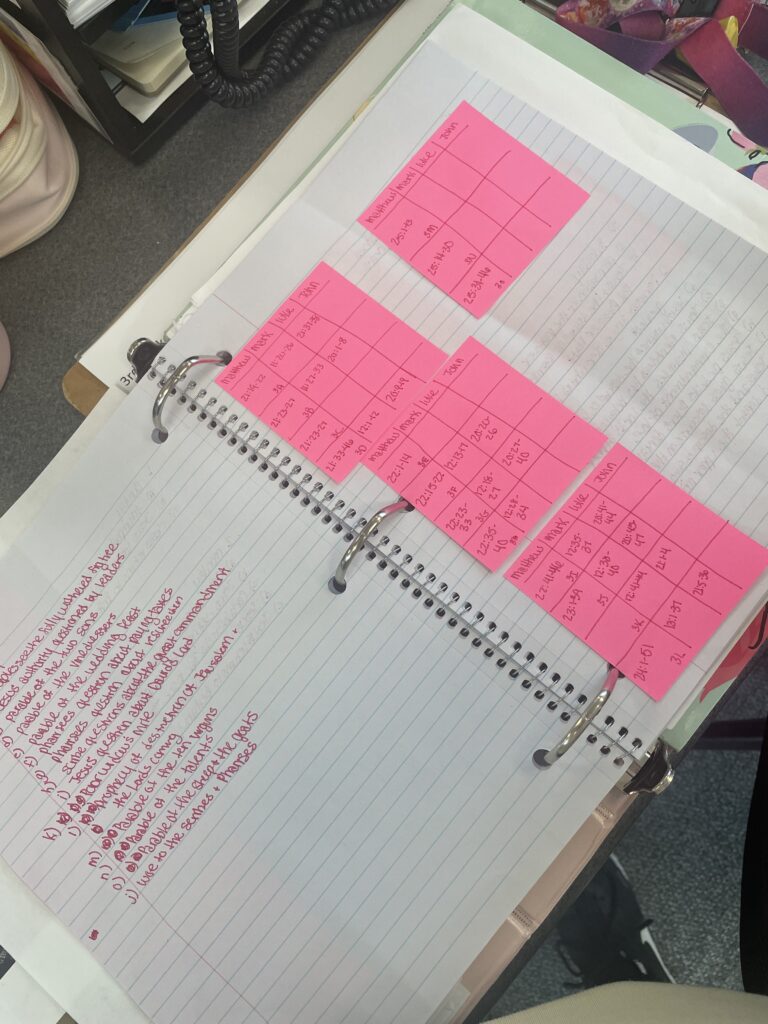
About two years ago, after spending time studying and refining the timeline, I began sharing the reading plan online and started writing reflections to go along with it. I realized that simply reading the events might not be enough, I wanted people to experience the story of Easter more deeply.
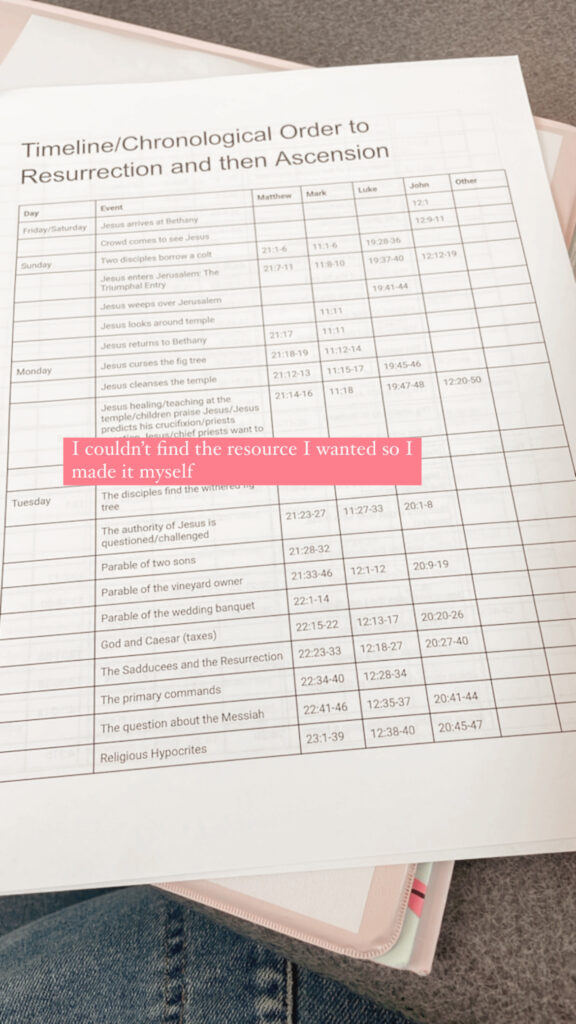
Once I had the events laid out, I worked to place them in order. There are some areas where the timeline is debated because the Bible does not always explicitly say something like, “And then on Thursday this happened.” Whenever I encountered confusion, I turned to commentaries and study resources to help piece together a thoughtful and historically informed chronological reading of Holy Week.
Coming from a history background, I love timelines. Timelines provide a visual and chronological structure that helps us understand the sequence, duration, and relationships between events. They help organize complex information and make it easier to see how a story unfolds.
Seeing the story of Easter laid out in a timeline and connecting each moment with the corresponding biblical passages helped my brain understand the story of Easter as one unified narrative. We often know intellectually that the Gospels tell one story, but because the accounts are not always presented in perfect chronological order, it can sometimes be difficult to see that unity clearly.
Over the past two Easter seasons, I shared this reading plan online because I wanted others to have access to it if they wished. But in my heart, I knew that simply reading the events might not be enough.
I wanted people to be transformed by the story of Easter.
I wanted readers to see how the story builds upon itself. How the tension grows, how the meaning deepens, and how the beauty of redemption becomes clearer with each moment. I wanted to help others see the full picture.
So I began to write.
My hope was that the words I wrote might help someone else experience the story of Easter in a deeper way. Now, three years later, that process has grown into a nine-day chronological reading of the final week of Jesus’ earthly ministry. (I added a few additional days so the entire story could be followed more clearly, rather than limiting it to a simple Sunday-to-Sunday structure.)
I am incredibly proud of this next step. I have spent a long time working on it, and I truly hope it will bless others.
Here on my blog, you will find the chronological reading plan for each day. I want this reading plan to be freely accessible to anyone who wants to walk through Holy Week in a deeper way.

For those who would like a guided devotional experience, the full devotional will also be available through my Etsy shop in both physical and digital formats.
The Pink Theologian Chronological Holy Week Reading Plan
Friday of Sorrows: Jesus arrives in Bethany
Palm Sunday: Triumphal Entry
Holy Monday: Temple Cleansing
Holy Tuesday: Temple Teaching
Spy Wednesday: Quiet preparation/betrayal planned
Maundy Thursday: The Last Supper
Good Friday: The Crucifixion
Holy Saturday: The Tomb
Easter Sunday: Resurrection
Friday of Sorrows:
- Jesus arrives at Bethany
- John 12:1
- Mary anoints Jesus
- John 12:2-8
- Crowd comes to see Jesus
- John 12:9-11
Palm Sunday
- Two disciples borrow a colt
- Matthew 21:1-6
- Mark 11:1-6
- Luke 19:28-36
- Jesus enters Jerusalem: The Triumphal Entry
- Matthew 21:7-11
- Mark 11:7-10
- Luke 19:37-40
- John 12:12-19
- Jesus weeps over Jerusalem
- Luke 19:41-44
- Jesus looks around the temple
- Mark 11:11
- Jesus returns to Bethany
- Matthew 21:17
- Mark 11:11
Holy Monday
- Jesus curses the fig tree
- Matthew 21:18-19
- Mark 11:12-14
- Jesus cleanses the temple
- Matthew 21:12-13
- Mark 11:15-17
- Luke 19:45-46
- Jesus healing/teaching at the temple/children praise Jesus/Jesus predicts his crucifixion/priests question Jesus/chief priests want to kill Jesus
- Matthew 21:14-16
- Mark 11:18
- Luke 19:47-48
- John 12:20-50
- Jesus returns to Bethany
- Mark 11:19
Holy Tuesday
- The disciples find the withered fig tree
- Matthew 21:20-22
- Mark 11:20-25
- The authority of Jesus is questioned/challenged
- Matthew 21:23-27
- Mark 11:27-33
- Luke 20:1-8
- Parable of two sons
- Matthew 21:18-31
- Parable of the vineyard owner
- Matthew 21:33-46
- Mark 12:1-12
- Luke 20:9-19
- Parable of the wedding banquet
- Matthew 22:1-14
- God and Caesar (taxes)
- Matthew 22:15-22
- Mark 12:13-17
- Luke 20:20-26
- The Sadducees and the Resurrection
- Matthew 22:23-22
- Mark 12:18-27
- Luke 20:27-40
- The primary commands
- Matthew 22:34-40
- Mark 12:28-34
- The question about the Messiah
- Matthew 22:41-46
- Mark 12:35-37
- Luke 20:41-44
- Religious Hypocrites Denounced/Warning against the scribes
- Matthew 23:1-39
- Mark 12:38-40
- Luke 20:45-47
- The widows gift
- Mark 12:41-44
- Luke 21:1-4
- Destruction of the temple predicted
- Matthew 24:1-2
- Mark 13:1-2
- Luke 21:5-6
- Signs of the end of the age
- Matthew 24:3-8
- Mark 13:3-8
- Luke 21:7-19
- Persecutions predicted
- Matthew 24:9-14
- Mark 13:9-13
- The Great Tribulation
- Matthew 24:15-28
- Mark 13:14-23
- The Destruction of Jerusalem
- Luke 21:20-24
- The coming of the Son of Man
- Matthew 24:29-31
- Mark 13:24-27
- Luke 21:25-28
- The parable of the fig tree
- Matthew 24:32-35
- Mark 13:28-31
- Luke 21:29-33
- No one knows the day or hour
- Matthew 24:36-44
- Mark 13:32-37
- Luke 21:34-38
- Faithful service to Christ
- Matthew 24:45-51
- The parable of the ten virgins
- Matthew 25:1-13
- The parable of the talents
- Matthew 25:14-30
- The parable of the sheep and goats
- Matthew 25:31-46
Spy Wednesday
- The plot to kill Jesus
- Matthew 26:1-5
- Mark 14:1-2
- Luke 22:1-2
- The second anointing at Bethany
- Matthew 26:6-13
- Mark 14:3-9
- Judas agrees to betray Jesus
- Matthew 26:14-16
- Mark 14:10-11
- Luke 22:3-6
Maundy Thursday
- Preparation for the Passover
- Matthew 26:17-19
- Mark 14:12-16
- Luke 22:7-13
- Jesus and the disciples assemble for the Passover feast
- Matthew 26:20
- Mark 14:17
- Luke 22:14-16
- John 13:1
- Disciples argue over who is the greatest
- Luke 22:24-30
- Jesus washes the disciples’ feet
- John 13:2-17
- Jesus identifies his betrayer
- Matthew 26:21-25
- Mark 14:18-21
- Luke 22:21-23
- John 13:18-30
- Jesus institutes the Last Supper
- Matthew 26:26-29
- Mark 14:22-25
- Luke 15-20
- The commandment of love
- John 13:31-35
- Jesus predicts Peter’s denial
- Matthew 26:31-35
- Mark 14:27-31
- Luke 22:31-34
- John 13:36-38
- Jesus gives discourse in the upper room
- John 14:1-31a
- Jesus and the disciples sing a hymn and depart the upper room
- Matthew 26:30
- Mark 14:26
- John 14:31b
Good Friday
- Jesus teaching on the way to Gethsemane
- John 15:1-16:33
- Jesus prays for himself, the disciples, and all believers
- John 17:1-26
- Jesus prays in Gethsemane
- Matthew 26:36-46
- Mark 14:32-42
- Luke 22:39-46
- John 18:1
- Jesus is betrayed and arrested
- Matthew 26:47-56
- Mark 14:43-52
- Luke 22:47-53
- John 18:2-12
- Jesus is brought before Annas
- John 18:13-14, 19-24
- Jesus is brought before Caiphas and the Sanhedrin and condemned and mistreated
- Matthew 26:57-68
- Mark 14:53-65
- Luke 22:54a, 63-65
- Peter denies Jesus three times
- Matthew 26:58, 69-75
- Mark 14:54, 66-72
- Luke 22:54-62
- John 18:15-18, 25-27
- Sanhedrin formally condemns Jesus
- Matthew 27:1-2
- Mark 15:1
- Luke 22:66-71
- Judas goes out and commits suicide
- Matthew 27:3-10
- Jesus appears before Pilate
- Matthew 27:2, 11-14
- Mark 15:1-5
- Luke 23:1-7
- John 18:28-38
- Jesus appears before Herod
- Luke 23:7-12
- Jesus appears before Pilate, is put up against Barabbas. Pilate consents to Jesus’ death
- Matthew 23:15-26
- Mark 15:6-15
- Luke 23:13-25
- John 18:38-40, 19:4-16
- Jesus is mocked by the Romans
- Matthew 27:27-31
- Mark 15:16-20
- John 19:1-5
- Jesus on the way to Golgotha
- Matthew 27:32-34
- Mark 15:21-23
- Luke 23:26-31
- John 19:17
- Jesus on the cross for the first three hours
- Matthew 27:35-44
- Mark 15:24-32
- Luke 23:32-43
- John 19:18-24
- Jesus on the cross for the final three hours
- Matthew 27:45-50
- Mark 15:33-37
- Luke 23:44, 46
- John 19:25-30
- Miracles accompanying the crucifixion
- Matthew 27: 51-56
- Mark 15:3841
- Luke 23:45, 47-49
- John 19:31-37
- Jesus’ burial
- Matthew 27:57-61
- Mark 15:42-47
- Luke 23:50-55
- John 19:38-42
Holy Saturday
- Jewish leaders secure the tomb
- Matthew 27:62-66
- The women observe the Sabbath day
- Luke 23:56
Easter Sunday
- There is a great earthquake, not to let Jesus out of the tomb but to permit witnesses to enter
- Matthew 28:2-4
- Mary Magdalene, May the mother of James, Salome, Joanna, and other women come to the tomb at daybreak, leaving their homes while it was still dark
- Matthew 28:1
- Mark 16:1-4
- Luke 24:1
- John 20:1
- Mary Magdalene runs to tell Peter and John
- John 20:2
- The other women enter the tomb and are addressed by the angel
- Matthew 28:5-8
- Mark 16:2-8
- Luke 24:2-7
- Peter and John arrive at the tomb after the women have left
- Luke 24:12
- John 20:3-10
- Jesus appears to Mary Magdalene
- Mark 16:9-11
- John 20:11-18
- Jesus appears to the other women
- Matthew 28:9-10
- The chief priests and the elders bribe the guards to cover up the resurrection
- Matthew 28:11-15
- The women tell the disciples
- Mark 16:10-11
- Luke 24:8-11
- John 20:18
- Jesus appears to the Emmaus disciples
- Mark 16:12-13
- Luke 24:13-35
- Jesus appears to Peter
- Mark 16:7
- Luke 24:34
- 1 Corinthians 15:5
- Jesus appears to the Ten in the locked room
- Mark 16:14
- Luke 24:36-49
- John 20:19-25
Want a printable version? Download the free Holy Week Reading Plan PDF below.
If you’d like a deeper experience walking through Holy Week, I created a 9-day devotional with devotional commentary and reflections for each day. You can find it in my Etsy shop in both digital and printed formats. Maybe 3 years from now I’ll have a full Bible study written over this topic.
No matter what comes next. I am so excited to be celebrating Easter in this way. To have the privilege of studying the Bible and to keep learning and growing. My prayer is that this reading plan helps you see the beauty of Easter more clearly and ultimately leads you to worship the One who redeemed us.

I’m only a few days into this study, and I’m thinking how can I extend this study. This is Amazing and I’m so blessed by what you’ve put into this indepth study. Thank you so much for your obedience and desire to help others lean into Christ. I’m thinking a chronological study of The Life of Jesus would be great for your next study. 😉
Blessings Marissa!