

Every year around New Year’s, I pray and seek the Lord about what I’ve done in the past year, where I want to go, and where He wants me to learn and grow. I usually get a word, or a verse, or both, and that becomes an anchor for me as I continue on in my faith journey.
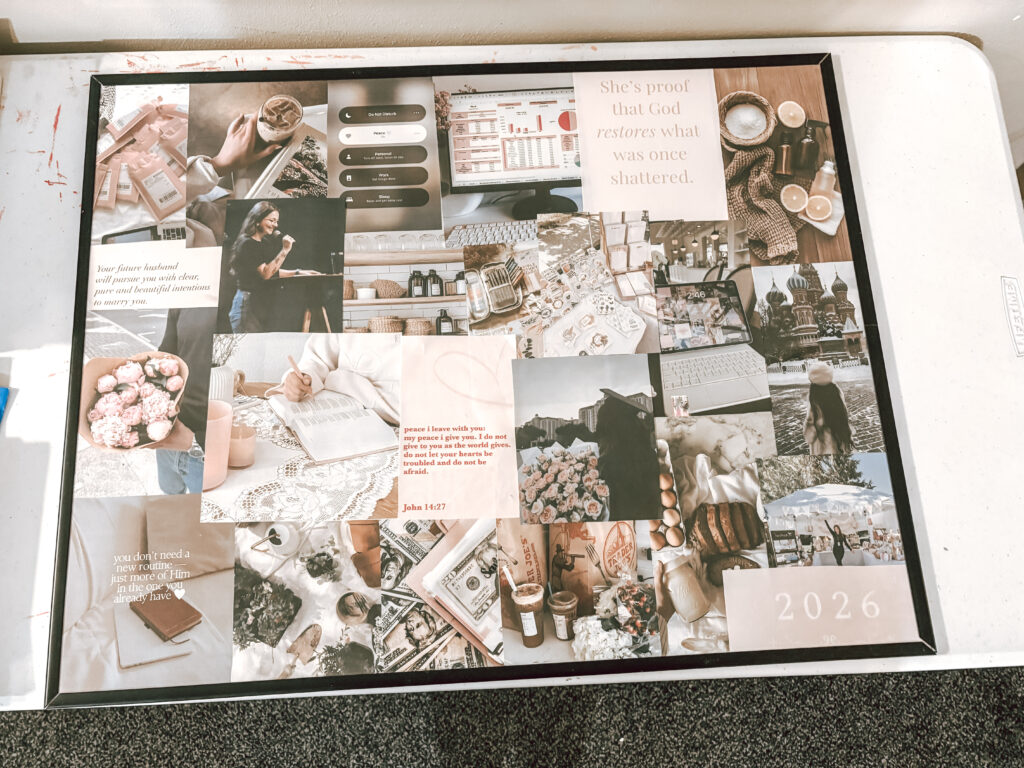
Towards the end of 2025, I went on a weekend trip with friends to a Brandon Lake concert in Des Moines, and we stopped by the Grotto of Redemption along the way. I was sitting by the pretty lake there, praying and journaling, when John 14:27 dropped into my heart and mind:
“Peace I leave with you, My peace I give to you; not as the world gives do I give to you. Let not your heart be troubled, neither let it be afraid.” (NKJV)
Peace became my word for this year.
Part of my process every January is also to build a kind of vision board. Not in a manifestation, name it and claim it kind of way, but a visual reminder of what I’m hoping for, dreaming of, praying for, and working towards. What I sense God wanting from me. And one thing He’s been speaking to me about, honestly, for a great many years, I’ve just excused it and been disobedient is that I need to get ahold of my health.
It’s Not About the Number on the Scale
I’m not talking specifically about my weight, or the size on the tag, or the number on the scale. I’m talking about caring for my body as a whole. The way I sleep, the way I eat, the way I move, the way I let myself rest.
I know for myself that a lot of my actions around food come back to a scarcity mindset. I’m worried about not having enough, so my unhealthy mind has learned that if I’m afraid I’m going to lose something, I need to use it all up at once. This shows up in the food I eat, in my spending, in how I use my time, it’s a fear of not-enough that consumes me on hard days.
If I’m honest, that fear isn’t really about food. It’s easier to blame a busy schedule or a hard season than to admit I’ve been avoiding what God has been gently asking of me for years. Hurry and self-protection have always felt safer than surrender.
Here’s the part I don’t often say out loud: when I was 16 or 17 years old, I was diagnosed with PCOS. By 22, I was diagnosed with Type 2 diabetes. For years after that, I kept gaining weight and simply stopped caring; about the diagnoses, about my body, about any of it. But in this season of healing, I’ve realized something freeing: the exhaustion, the lack of sleep, the restlessness, the cravings, the extra body hair, the list of symptoms I’d learned to just live with do not have to be my portion forever.
My dream, one day, is to be a wife and a mother. But I’ve come to believe that the waiting season I’m in now isn’t a holding pattern, my life doesn’t begin only once I have those things. So I’m doing the work now, in this season, instead of waiting for some future version of myself to start. Doing this work when I was younger might have been easier. But I’m 30 now, and that’s still worth starting.
We Are Made in His Image, Not Made to Be Our Own Provider
I’ve been learning a lot lately about trust and that God is my Provider, and that I can rest in Him to take care of what I need. This need I have for control is really me trying to force myself into the role that belongs to Him alone.
Scripture tells us we’re made in the image of God — the imago Dei — and that carries a weight I don’t think I fully understood until recently. Genesis 1 tells us God formed mankind to be His vice-regents on the earth, His representatives, ruling and stewarding creation on His behalf (Gen. 1:27–28; Ps. 8:5–8). In the ancient world, a king would often place a statue of himself in the cities he ruled, so his people would remember whose authority they lived under. Genesis 2 pictures something similar: God fashions Adam from the dust and places him in Eden, a living image, set there to rule as God’s representative.
But here’s what struck me most: Adam wasn’t made ex nihilo, out of nothing, the way God alone can create. He was made from the ground, from adamah, and given the name adam to match. His authority was never his own. It was given, on loan, from the true King. As long as Adam remembered he was “dirt-man,” dependent and derivative, he could rule well. The moment he forgot that and started reaching for a status that was never his to grasp everything unraveled.
I think that’s my story too, in a smaller, more mini sized version. G.K. Chesterton once observed that humility isn’t thinking little of yourself so much as it’s forgetting yourself altogether, and that’s exactly what I lose sight of when I grip too tightly to control. C.S. Lewis went further still, naming pride, the desire to be self-sufficient, to need no one, not even God as the deepest root behind every other sin. My scarcity mindset, my compulsive “use it all up now,” is really just Adam’s temptation wearing a modern face: forgetting I am dust, forgetting that God is the One who provides.
Stewardship, Not Hoarding
This is where the parable of the talents has become such a gift to me (Matt. 25:14–30). A master entrusts his servants with talents, these can be resources, gifts, responsibilities according to their ability. Two servants invest what they’re given and it multiplies. One servant, who was afraid, buries his single talent in the ground rather than risk using it.
That servant’s problem wasn’t a lack of ability. It was fear, a conviction that he didn’t have enough, so he’d rather hide what he had than risk stewarding it well. I see myself in him. My health is a gift entrusted to me, and for a long time I buried it rather than stewarded it, because some fearful part of me didn’t trust there would be more grace, more time, more provision if I spent what I had wisely.
But Scripture reminds me my limits themselves are a gift, not a curse. “As for man, his days are like grass… but the mercy of the LORD is from everlasting to everlasting” (Ps. 103:15, 17). The Psalmist even calls the boundary lines of our lives pleasant (Ps. 16:6). Thomas Aquinas taught that the virtues are rightly ordered desires, good things, wanted and used within their proper measure and I think that’s exactly what I’m learning now. Health isn’t found in denying my body or indulging it without thought, but in rightly ordering what I want and how I care for what I’ve been given.
The Theology of a Tea Cup
One of the things I’ve learned in getting my hormones and health under control is that my love affair with caffeine has been part of the problem. I LOVE iced coffee, I am a true Jesus and coffee girl. But I’ve learned that the amount of caffeine I was taking in: 2+ iced lattes and an afternoon energy drink, was putting my body into chaos. My cortisol was elevated, and my body was living in a near-constant state of fight-or-flight.
So I switched (mostly) from coffee to tea. I still enjoy an iced coffee now and then, just less often and in smaller amounts. And the one thing I did not expect is how much slower tea is. Coffee, for me, was five minutes max (if that): instant espresso, sugar-free syrup, ice, milk, done. Tea refuses to be rushed. You fill the kettle, wait for it to heat, steep the bag for 3-5 minutes, and then wait again because it’s too hot to drink. Iced tea is worse, the kind I make takes 8-10 hours in the fridge before it’s ready.
This new rhythm has been the biggest adjustment of all, not so much the ingredients, but the pace.
And it’s taught me something I didn’t expect a teacup to teach: hurry and fast have never been God’s design for any of our lives. Galatians 5:22–23 lists the fruit of the Spirit: love, joy, peace, patience, kindness, goodness, faithfulness, gentleness, self-control and not one of them is available to a hurried soul. You cannot rush your way into patience. You cannot hurry your way into peace.
The Sabbath Was Made So We Wouldn’t Live Exhausted
Losing weight, tracking food, cooking from scratch, making time for lower-impact movement instead of high-intensity workouts, all of it has forced me to slow down and be deliberate. And the more I slow down, the more I see how deeply our culture has sold us the lie that hurry equals worth. If our calendars are full, we assume we’re being productive. If they’re empty, we panic.
But Jesus said plainly, “The Sabbath was made for man” (Mark 2:27). Just as Eve was given so man wouldn’t have to live alone, the Sabbath was given so man wouldn’t have to live exhausted. It’s not simply a rule to check off, it’s a gift, a rhythm woven into creation itself, reminding us weekly (and I’d argue, in small daily moments too) that we are not God, and we were never meant to carry what only He can carry.
Dietrich Bonhoeffer wrote so much about the discipline of stillness and silence as a form of resistance, a refusal to keep asserting ourselves, a willingness to let God be God while we simply rest in His presence. Busyness, when I’m honest, is often just a subtle way of trying to be omnipresent and all-sufficient, trying to be God rather than trust Him. A slower life, a cup of tea steeping on the stove, becomes a small daily reminder that I am not God, and I don’t have to be.
And ultimately, this isn’t about a practice at all, it’s about a Person. Jesus says, “Come to Me, all you who labor and are heavy laden, and I will give you rest” (Matt. 11:28–29, NKJV). Every Sabbath, every unhurried moment, is a shadow pointing to Him. As one pastor beautifully put it, Christ lets the frenetic pace of the heart slow down into calm sanity. No amount of vacation, no scrolling, no escapism gives us that kind of rest. Only running to Him does.
A Small Sabbath in a Teacup
I don’t think God needed to teach me all of this through tea. But He did, because I needed something slow enough, ordinary enough, repeated enough, to retrain a heart that has spent years hurrying past His invitations to rest.
So now, when I fill the kettle and wait, I’m practicing something holy: trusting that I don’t have to use it all up right now, that my limits are good, that my body is a temple I get to steward rather than a burden I have to control (1 Cor. 6:19–20; Rom. 12:1). And someday, this dust-formed, aging, imperfect body will be made new completely (1 Cor. 15:42–44), so every small, faithful, unhurried choice I make now is a little rehearsal for the rest that’s still to come.
Until then, I’ll keep steeping my tea a little too long, and letting the Lord teach me what it means to be at peace.

This is SO good dear friend. I’m so proud of your obedience and willingness to hear the Lord.